Lessons from a marathon
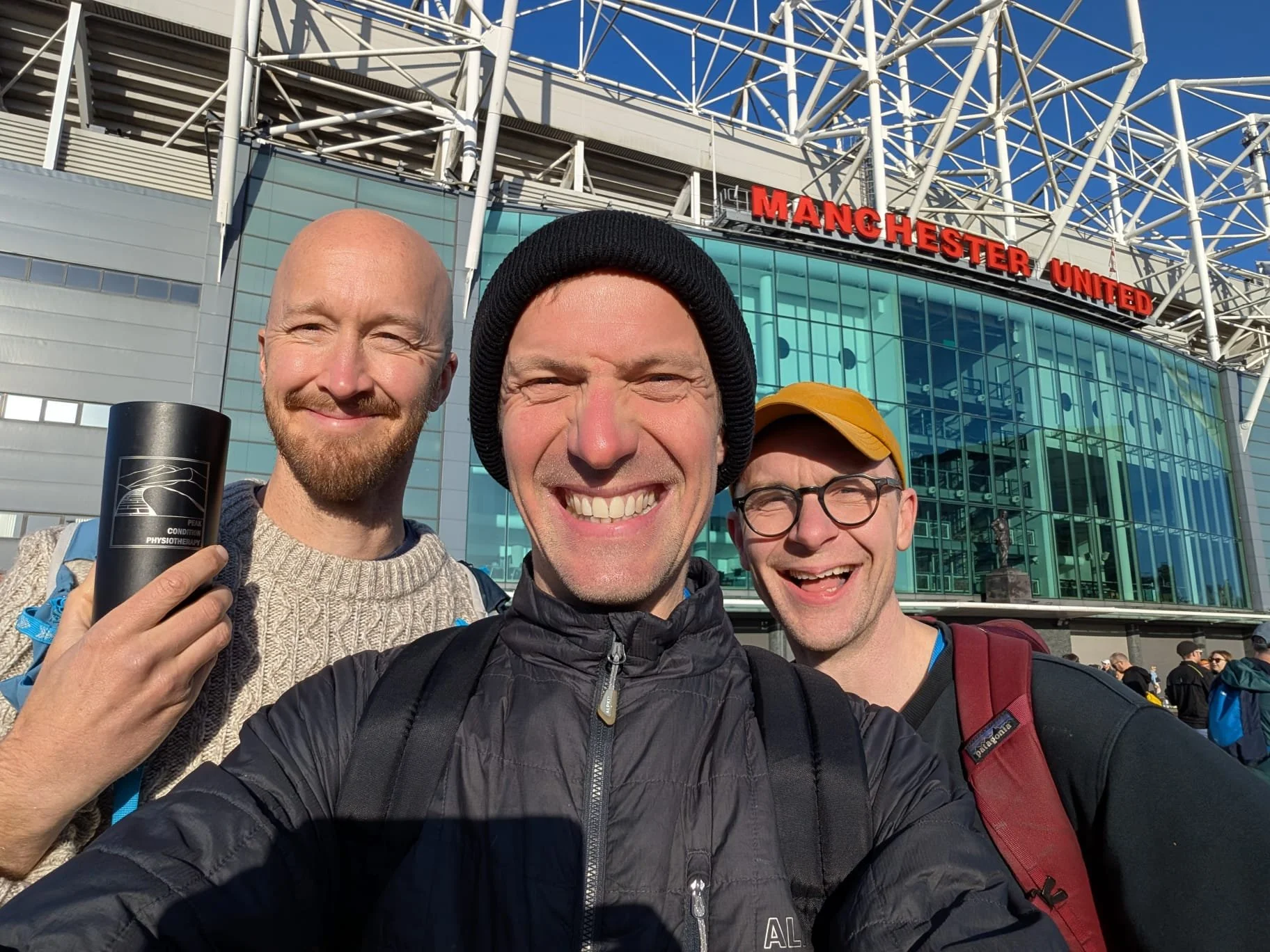
Getting to the start with my friends Josh, Lawrence and Sir Alex Ferguson
First of all, I really enjoyed that and I’m very pleased with the outcome. When I say enjoy… the first K felt great. It felt so easy and I thought I could do this forever provided it wouldn’t get boring. Unfortunately either I was swept along, accidentally sped up or sped up more than I needed but come mile 13 I thought… “hmm this is starting to let me know in my legs”. Although they were feeling better than my similarly paced half marathon in February and I was sugaring myself well (I had a total of 11 gels - if you include the one 20 mins before the start). They were 22g of carbs each and I still think I could have had more, my stomach was fine with them.
But this is where I need to confess. That if it doesn’t get boring line… Well it didn’t get boring, it got a bit harder. I had a solid plan at aid stations - always take water. Always sip to help with those gels that you’re having. The rest of the bottle, squeeze out onto the back of your neck or pour onto your head. The sun was out and it was getting warm in some parts. I didn’t want to overcook.
Around mile 13, out of nowhere a water bottle flew at my feet. Horror! I rolled my ankle, which can go some distance in these super shoes. But it was okay. No pain. Must have recovered it. The 2.50 pacer had moved ahead (Yes, slightly ahead of 2.52 target - I had been running purely off ‘feel’ - being in a big group around the pacer felt comfortable) . I caught up.
But now at mile 17 it was feeling like hard work to keep with the group. I decided to go for a caffeine gel.
Now I’ve noticed recently that I respond quite a lot to caffeine and at home go for a decaf. I supped a gel and saw two of my friends who had crossed the Peak District to cheer me on. I felt special. I felt caffeinated. I felt lucky for all the lovely people in my life and my cat. Yes she was on my shoes and now in my thoughts. Was this some kind of mental episode? Probably - You try running right on the edge of comfort for 2 hours. I caught the 2 hr 50 pacer and thought “I’ve got this”.
But then the Devil arrived on my shoulder - “Why catch him when you can pass him?”. “This is hard work, imagine you ran under 2hrs50, would you ever need to run a marathon again?”
A guy I had been exchanging words with (chatting is a bit over an overstatement for marathon pace) asked me what I was doing. Was I going for 3.50 per k. “I don’t f*****g know, I just feel good”
3 mins 51 and 1km later I was questioning my wisdom. I tried to keep the pace but my legs had other ideas. I tried more caffeinated gels but they lacked the magical powers of idiocy. I started thinking “oh no, you’ve spoilt it”. But not this guy. I spoke to myself kindly, come on Charles. Out loud, “Come on Baker”.
Yes I was getting slower, taking punches - 4.06, 4.09, 4.10, 4.20, 4.18, 4.35 (nooooo) 4.27 (on the ropes), 4.42 (punch to the head), 4.39 (another knockdown), 4.28 (back up and waddling around the ring), 4.15, 4.20. The last 400m 3.47 - YES, YES, YES - it was on my bib after all
I think Science can explain the slowing - running out of sugar and tipping over my lactate threshold at a rate I couldn’t handle.
But I think it’s better to put simply I didn’t hold my nerve, in a weird way I chickened out by running faster. Sometimes the hardest thing to do is just trust where you are and hold strong.
The race did what I wanted it to. It gave me confidence that I could run faster marathons than I had previously. I feel like I could go faster again if I went back with this years lessons. Next year I would train a little harder (not much) and remind myself of this marathon’s lessons. Hold your nerves people! They will be there. Don’t sprint for the line before you can see it! I can’t wait to sprint under the line at next years London or Seville!
Reading a fellow Coaster (Jason Moore) talking about how the marathon is already ran with his training made me smile. He is right, it’s not just about the day - it’s the build up and everything that you put in that makes a marathon special. A lot of people would not even dare try to run a marathon. In trying alone I think people deserve respect. Do all the right things and trust yourself right up until the finishing line is in sight! Then and only then can you let it all loose…. I’m sure the result will be a huge smile and a medal to hang up in the bathroom.
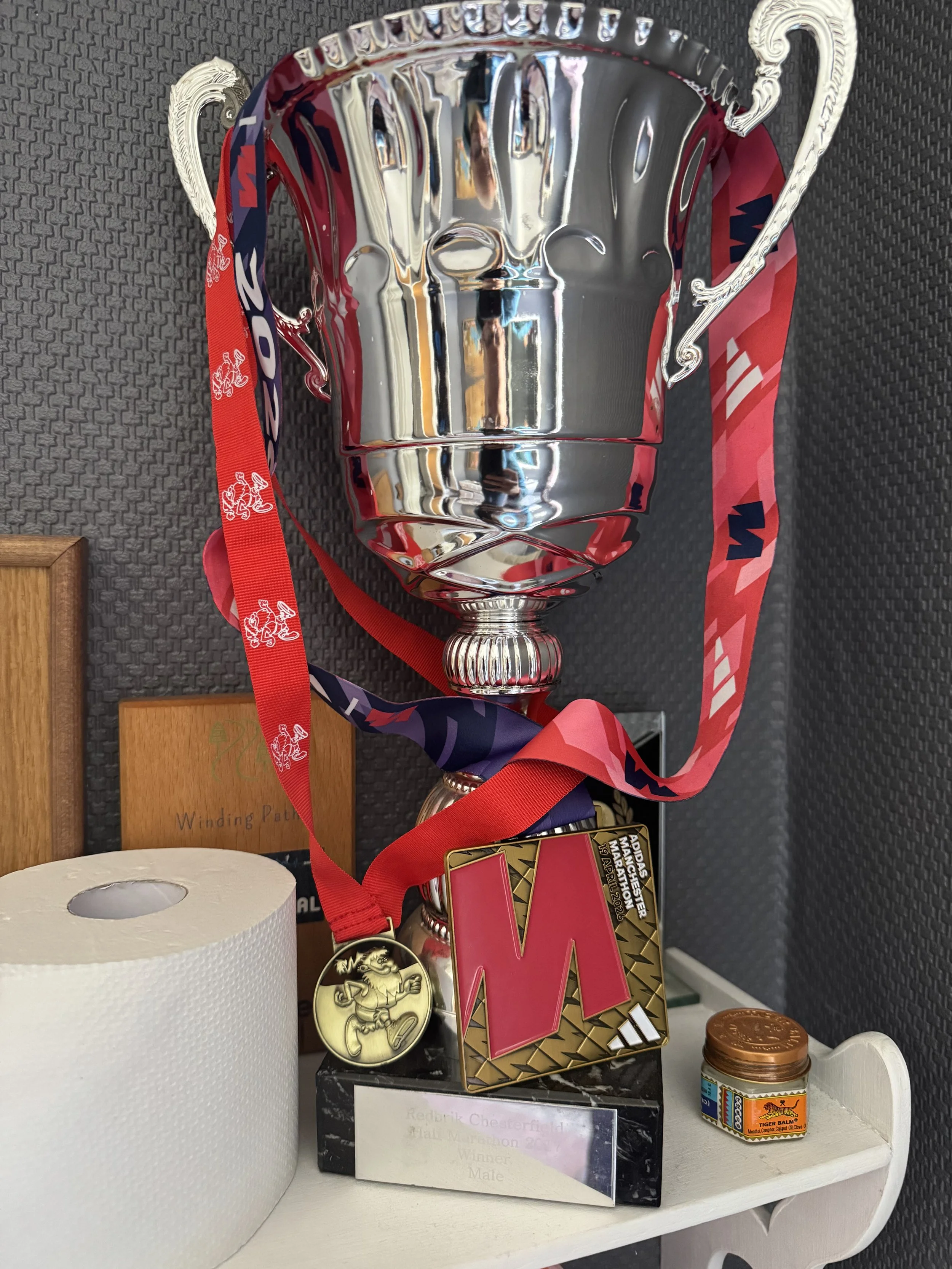
Manchester Marathon Trophy hanging proud!
Good for age?
7 days to go and I thought I would have a little reflect before planning ahead of next week’s marathon.
I’ve settled on a target. One that feels meaningful, possible and challenging.
It’s hard not to compare to previous runs and it’s sometimes hard not to put too much hope into your fitness. However I have been trying to run the long runs to ‘feel’ (with a little looking at the watch) and the good news is that they have been feeling good. Good for age.
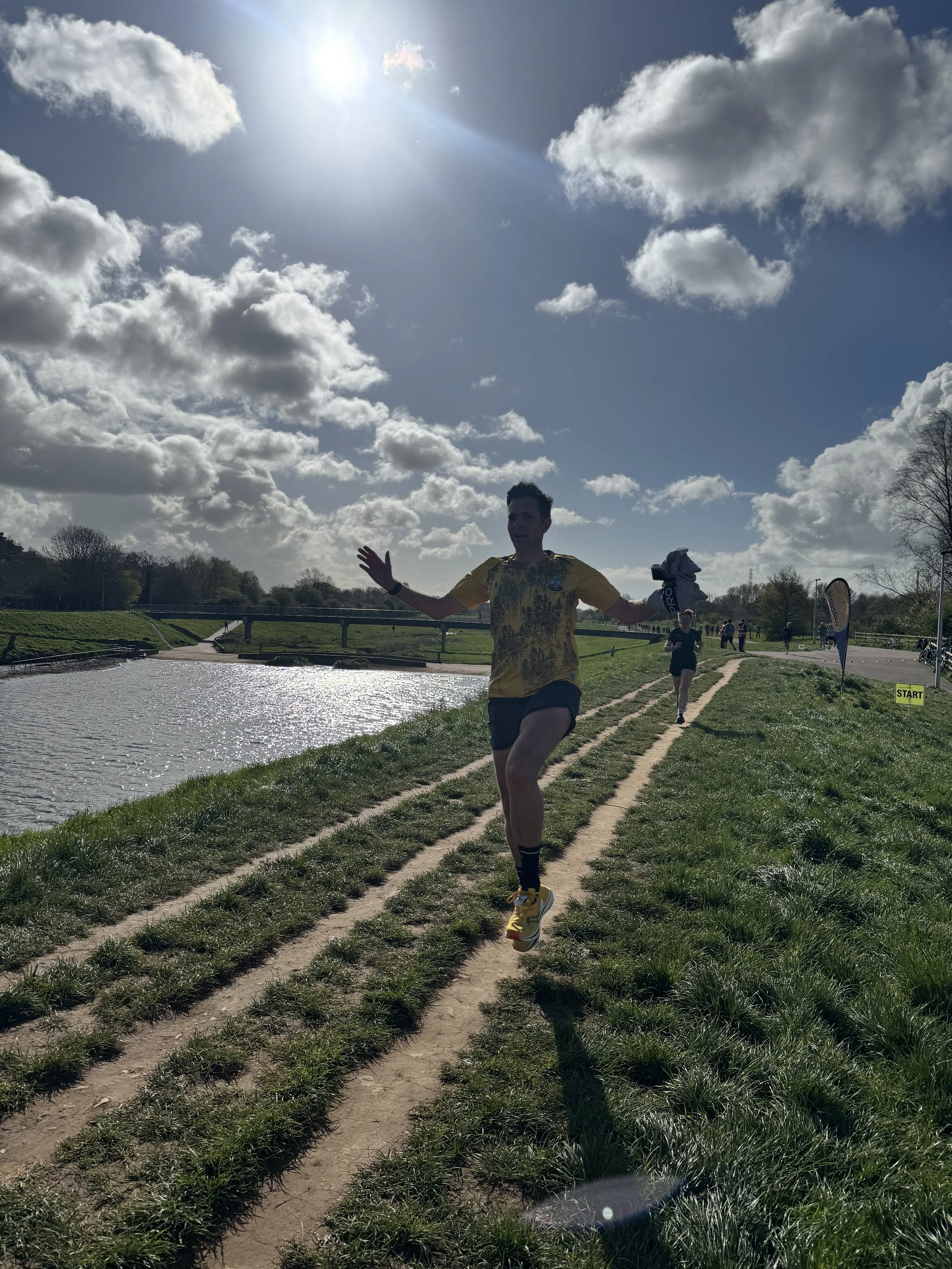
Charles Edmonds at Exeter Riverside Park Run (another young Charles from Dawlish Coasters) - It’s been great incorporating Park Runs into the long run to make it more sociable
I think that good for age (London Marathon have qualifying times based on your age) and age gradings are a lovely thing. It’s hard as we slow down or stop getting faster to be encouraged by our running. However the race against time (thank you Richard Askwith) feels like a meaningful one.
https://richardaskwith.co.uk/books/the_race_against_time/
I would like to age gracefully, if possible. I believe that involves staying strong and healthy. Sometimes I wonder if my generation are too focused on longevity and health but then I think about people in care homes, who have lost their independence to frailty and fragility. I would like to be strong, healthy and active as I age. If illness takes me then that would be bad and sad, but at least I’ve given myself the best chance. Cheery stuff….
Well it sort of is. I would like to get good for age at the marathon - 2 hours 52 minutes. The upper limit of my age category is 39. This is the last marathon I will run in my 30’s. What a way that would be to sign out! It would also open the idea of London 2027. If this one goes well, I expect to feel encouraged to do even better next year.
In May this year, I will be 40 and people keep saying I don’t look it. Stop it, you’re too kind. Weirdly I haven’t been I’D since I started looking like an Ade Edmondson impersonator. But it gets you thinking. Quite positively in fact. The pressure to push myself and PB all the time is gently washing out to sea. This means I think more about will that race be fun? Running can become less goal driven and maybe even more rewarding.
But the Marathon, the Marathon is very often about time. I’ve been to Manchester. I’m not really a city centre kind of guy. If you asked me where would I like to run 26 miles I can’t imagine I would say Manchester to Altrincham please! So it would be silly to hide that this isn’t about pushing myself, trying to achieve something. I think I can run something I will be proud of. Learn more about what works for the Marathon and with this information I can also help other people. I went into this training block a little late from illness. So I targeted the things I thought were most important. Training Volume and the Long Run:
Training volume - how much running you clock up - increases your aerobic capacity. The power of your heart and lungs to pump blood around the body. Taking fuel to the muscles and taking away the waste. The Marathon is an aerobic event. Training volume here will be key. Elite marathon runners run 120 miles per week. With a big base build I think I could manage 120km per week but only if work was quiet and all my ducks were in order. In Dawlish this Winter it’s been a tough winter for Ducks. But I’m really pleased with my running volume that I achieved after four weeks off:
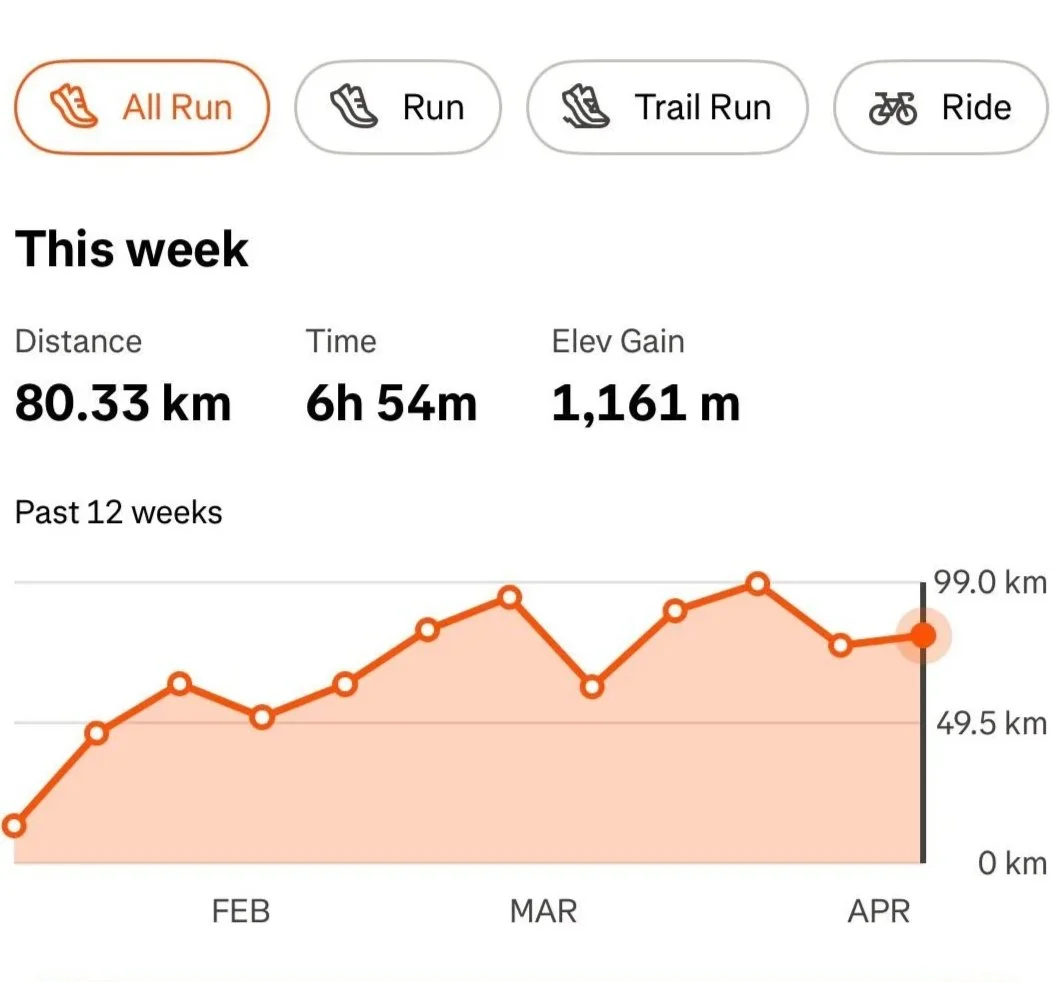
The weekly kilometres since returning to running on the week beginning 5th January until last Sunday.
The Long Run - If there was a key run to prepare for the marathon it’s the long run. If I am in great 5k shape I am sure I will run well for the first 5-10k but then it starts to become as the famous Sir Alex Ferguson used to say “squeaky bum time”. To be confident at the marathon you want to have ran some long runs. You want to feel that your body has the stamina, is ready to endure mile after mile. Practicing the long run prepares your tissues to sustain the load the body is about to be put under. The long runs help you to build confidence. They are also fantastic for that aerobic system mentioned earlier. A lot of people sometimes find they become faster across all distances when training for a marathon. After you recover and the fatigue leaves you, having completed a marathon can leave you feeling like a very different runner.
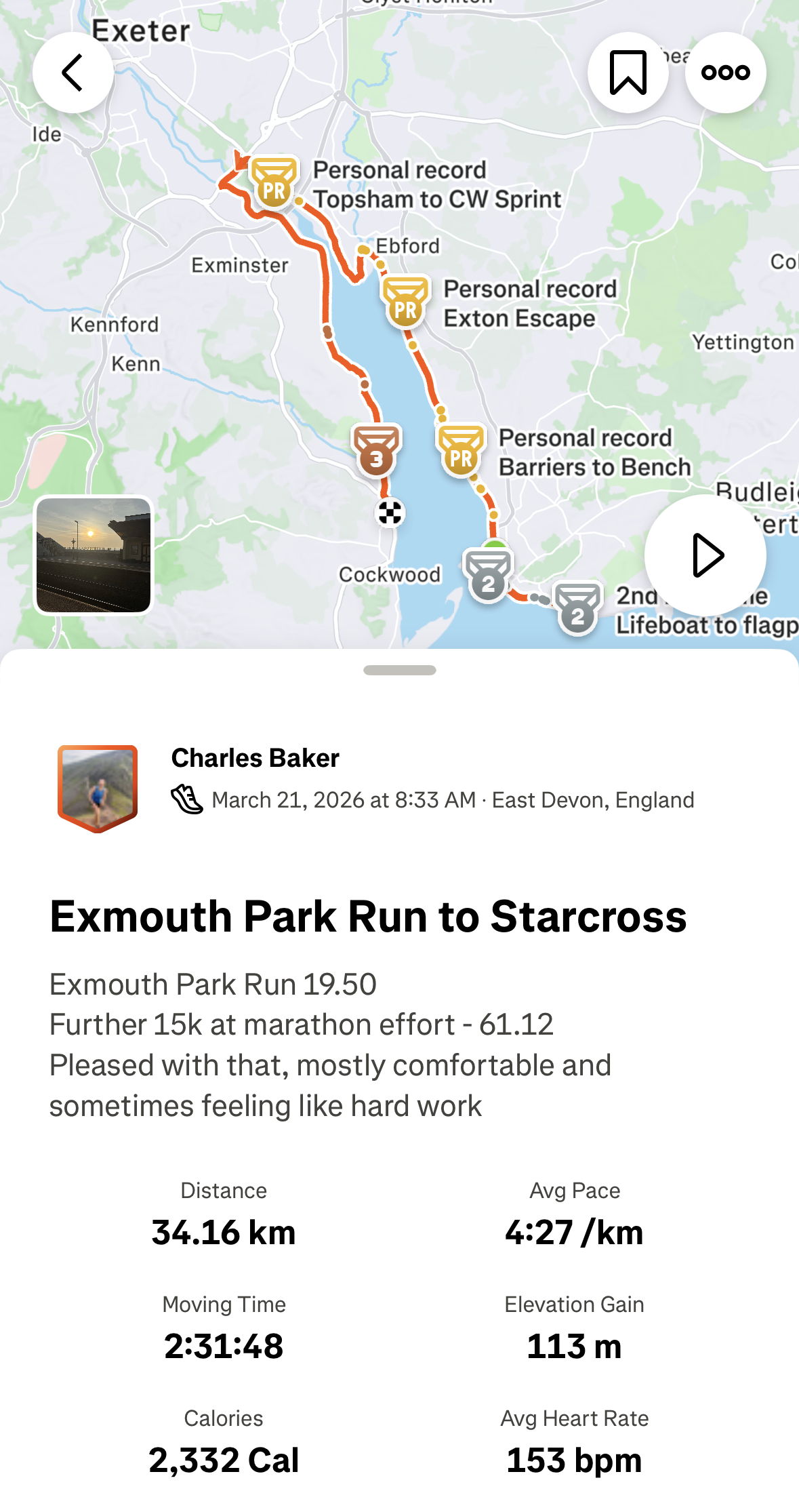
This was my longest run with a good chunk of Marathon effort and it felt good.
Past Marathons were run around 4 minutes per k until the wheels fell off. I hope that I am solving that with better fuelling. 2hrs52 would mean 4.05. So I am allowing that I am not in the fastest shape I’ve ever been in but still believe I could knock 5 minutes off my Pb by running a well paced sensible race.
In the last 5 years I feel older yes but perhaps wiser. My self talk has improved a great deal. I have run almost all the long runs without any music. I am happy in my head and my favourite technique is to talk to myself in the third person. “Go on Chas”, “Come on Baker” and “You can do this Charles”.
If I get extra carried away it might blurt out of my mouth. I remember when people used to phone the home phone in my teenage years. Before the maturation of my vocal cords people would say “Gill?” Then came the proud moment when someone called and they enquired “Will?” Sometimes if I accidentally blurt out my positive self talk my own voice sounds like it’s my Dad. It’s as good as I’ve got to hear from him. As I say he would always encourage me and this is like a wind in my sails. I heard of this talking to yourself in the third person technique in a book called ‘Chatter: The Voice in our head and how to harness it’ by Ethan Cross. There was lots more good in that book. But this one really stuck with me.
When it comes to the marathon the best advice I have been given is;
Run 10 miles with your head - stay calm, keep cool, don’t sprint off with your freshly tapered legs and do anything silly
Run 10 miles with your legs - you have trained to run 20 miles in the build up. You’re just repeating that. You are prepared
Run 10 km with your heart - if you want this it’s time to throw the kitchen sink at it. It’s going to hurt but you are stronger than you might think
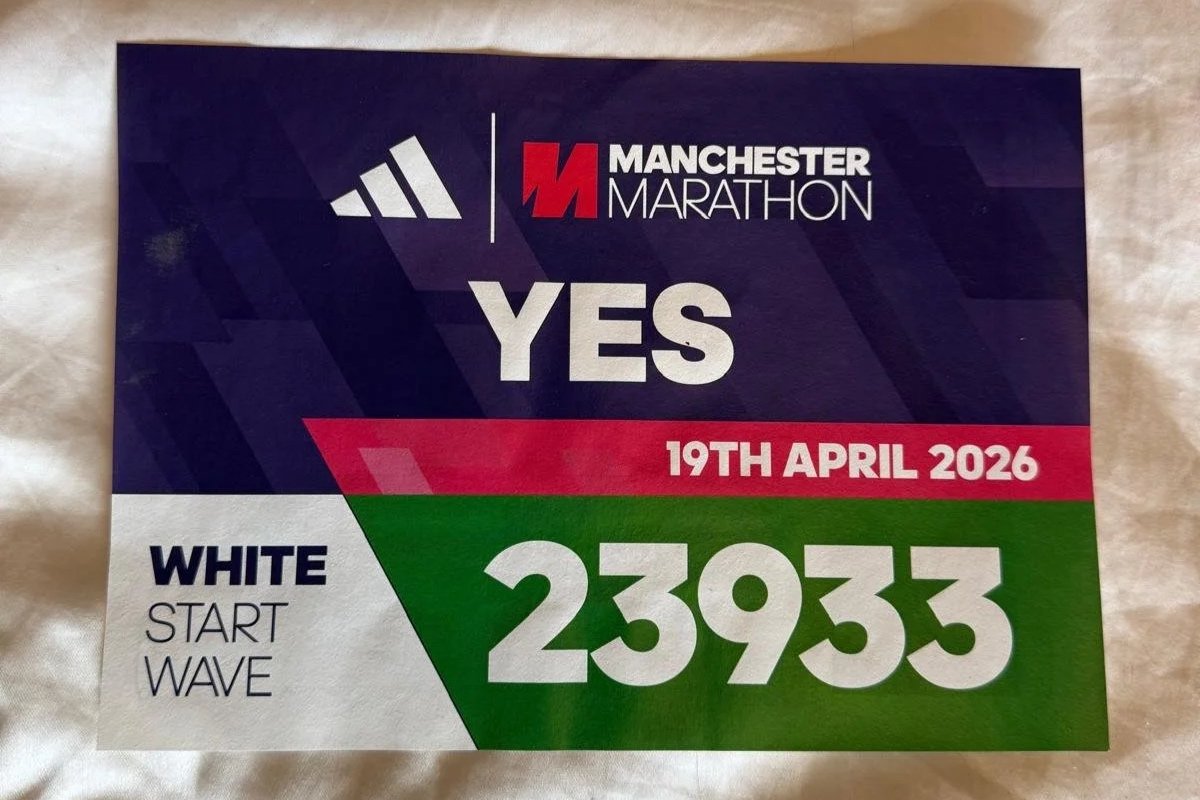
Next Sunday I am number 23933. My name is Yes.
If you want to check in I think Adidas have an app (I think I will be called Charles Baker)
Otherwise I am sure I will tell you all about it when I get back
Until then all the best and good luck with your running
BTC
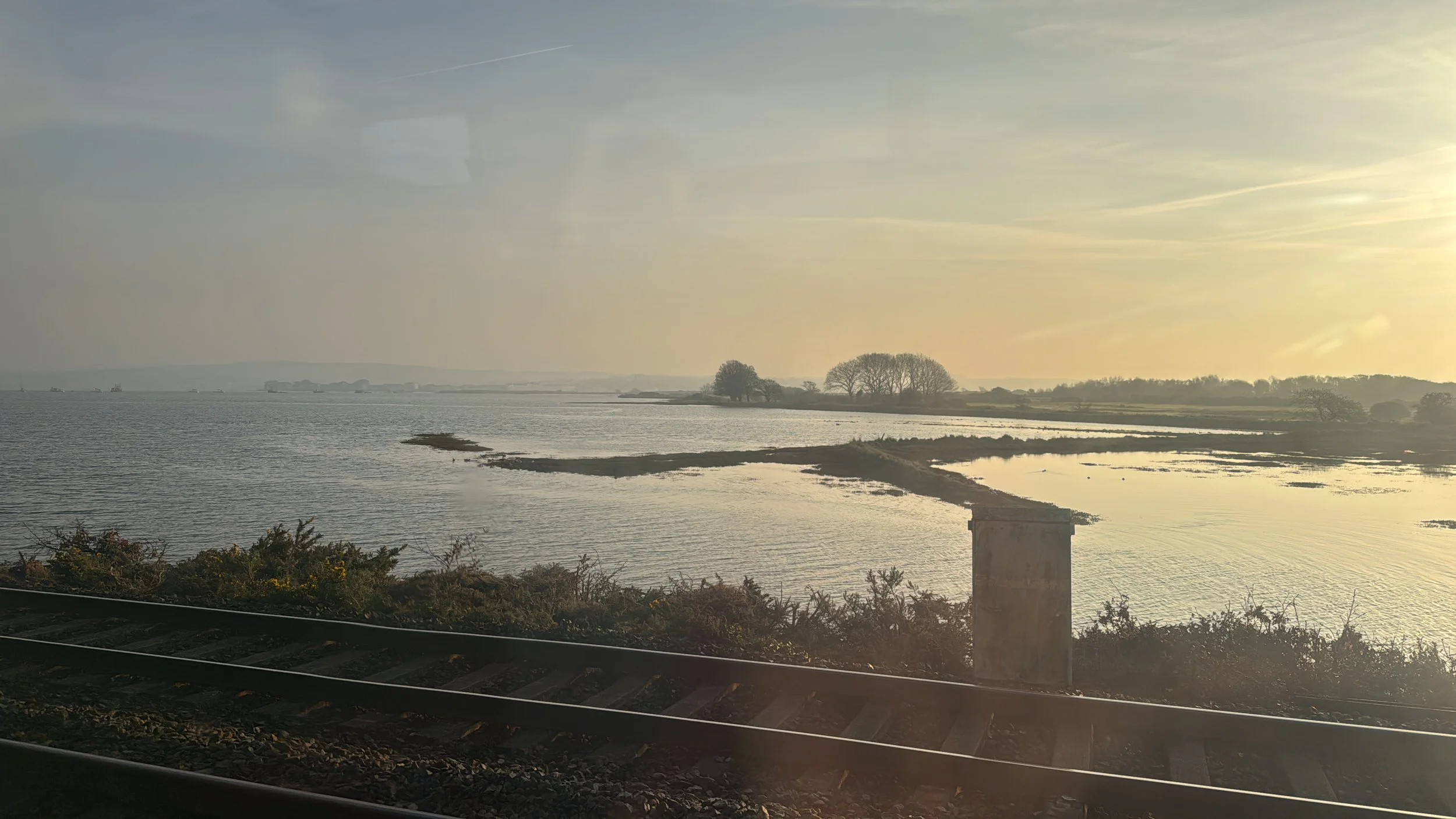
You’d be a fool not to fuel
Something that appears to have importance beyond getting your training runs right is taking on enough carbohydrates or as I like to call it “sugaring yourself”
I didn’t always believe this was important. Initially I filed ‘race nutrition’ in the taking it too seriously bracket of recreational running. Funny for someone who was an obsessed with getting up to 70 miles a week for his marathon training to the point he had shin splints 3 times in as many marathon builds…
I thought oh gels. That’s just marketing. Was Pheidippidies supping on science in sport when he ran the first ever marathon? No! Did he then collapse and die… errr
I really thought fitness was earned and gels were sort of cheating. Much like the wisdom of drinking on an empty stomach. There’s lots of things I would like to go back and have a word with young Charlie about but we are where we are.
And what a place I am (mobile phone won’t let me post a pic of the river exe here… please imagine its beauty)
I’m on the train to Exmouth. For the second of my big runs with marathon effort in. Today the plan is 34-35k with 20 at marathon effort. I’ve come round to the idea of sugaring myself because I took that seriously on my three ultra distance runs and it really helped.
Also let’s look back again at the marathon performances. Lewa 3.18 - 2 gels (except I gave one to a Kenyan I got chatting to mid race only for him to overtake me as my quads ran out of energy…. Hmm 🤔). Lake Toya - fell apart around mile 21 after feeling great. Can’t remember having gels there. London - looking good for 2.45 early on but only taking two untested Gu gels, finishing in 3.03
I blamed the training. But I did wonder about carbohydrates. I liked them in every other walk of life
In my race belt today are 7 gels with 23g of carbohydrates in each of them. I also have a flask of tailwind containing about 50g. I’ve had a big bowl of porridge. I had more gels last week and I’m convinced they will help. This is a dress rehearsal today but obviously I’m not running the full marathon distance. That might be a bit much four weeks out from the race.
However the best bit of nutrition today will be when I go to the local scoop in Dawlish after the run for a double croissant waffle with ice cream. Again carbohydrates are needed for recovery and there is protein in ice cream. Eat like a champion and you might just run like one….
Surf Operator

Arrifana Beach, Algarve, Portugal
I should be writing about running and how I’ve been putting the miles in (which I have). But despite this, I find myself wanting to write about surfing.
At school in Totnes I had a couple of friends who surfed. I had the hair for it…
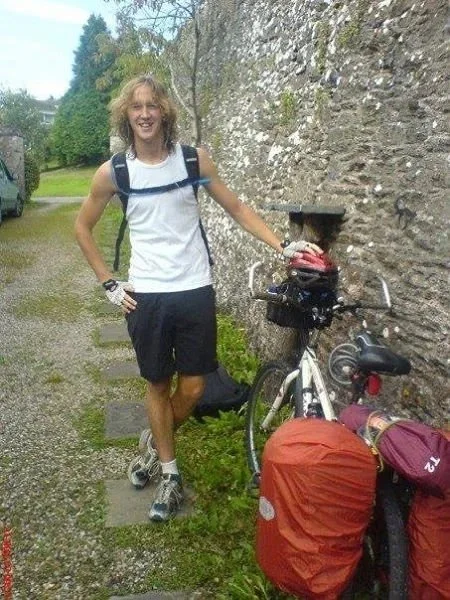
Could have been a surfer?
But I never got into surfing. I remember they took me to Bantham Beach once. I can’t even remember if there was a board for me. I just remember being cold, really cold and struggling to get out of a wetsuit. I’ve never particularly liked being cold. All the kids who surfed at school were cool. I didn’t see myself as one of the cool kids, even if some of them were my friends - so surfing wasn’t pursued.
More recently (New Years 24/25). I was reintroduced to surfing. Nearly forty, what a time to start a really hard sport. However, I stood up in the white water and I was so happy. I loved the experience - the ocean, trying to pick your wave, being swept along and getting warm afterwards!
When booking a running holiday for one, I wondered, what else could I do? Since being back in Devon I have loved being by the sea, I loved surfing when I tried it, so why not go somewhere I could do that? The South West of Portugal sounded good, I love a Pastel de nata - perfect!
How is this linked to running? Good point - Could I not talk about the threshold session I did yesterday- 3 x 8 mins off 2 - the importance of this kind of training for your best marathon? Or the 100km in 6 days to build volume since arriving in Portugal? No, let’s talk about surfing…
I took three lessons. Two private and one group. The private lessons were amazing. Lesson one we practically had the beach to ourselves.

Praia de Monte Clérigo - Lesson 1
We warmed up in the sun and then went over my pop up. This lesson and the next were full of information - where to put my feet, push my weight, to look forwards and not down at the board… every time I stood up and fell off there was something new. The waves came hard and fast. I felt like I’d been in a washing machine. It was tiring but I was enjoying it. The second lesson was similar and I started to feel I was letting my kind instructor down. There was so much to think of and I often think of how other people are feeling, so my brain was full!! Heading back out to sea I was trying to tell myself to relax. But then the big waves would be back. This was hard but my spirits were high and I wasn’t giving up.
After the second lesson I was tired and watched a new George Clooney film. George’s character was cool 😎 and he played ‘Sade - Smooth Operator’ in his car. This made me laugh. It was also the inspiration for a later light bulb moment.
As I walked down the hill for my third lesson. I listened to Sade again, I decided that this would be my surfing song…
Rather than worry about what went wrong each time I fell off and start to get weighed down in how hard it was, I would stand up, look out to sea and “Smooth Operator”. It was almost is if the saxophone was playing, cheering me on.
The sun shone, I smiled, I continued to fall off but I thought “I’m learning and this is fun”. This isn’t about being the best surfer it was about enjoying being in the sea.
Wave after wave, rep after rep, I “moved in space with minimum waste” on my last wave of the lesson it all clicked. I felt so comfortable I turned to my instructor still speeding along and gave her a double thumbs up 👍 -It had been a great day
And that’s what running is too; Step by step, all these steps are reps - the more you can relax and enjoy the process the further they will take you.
If you need to pick your head up I would recommend a theme tune…
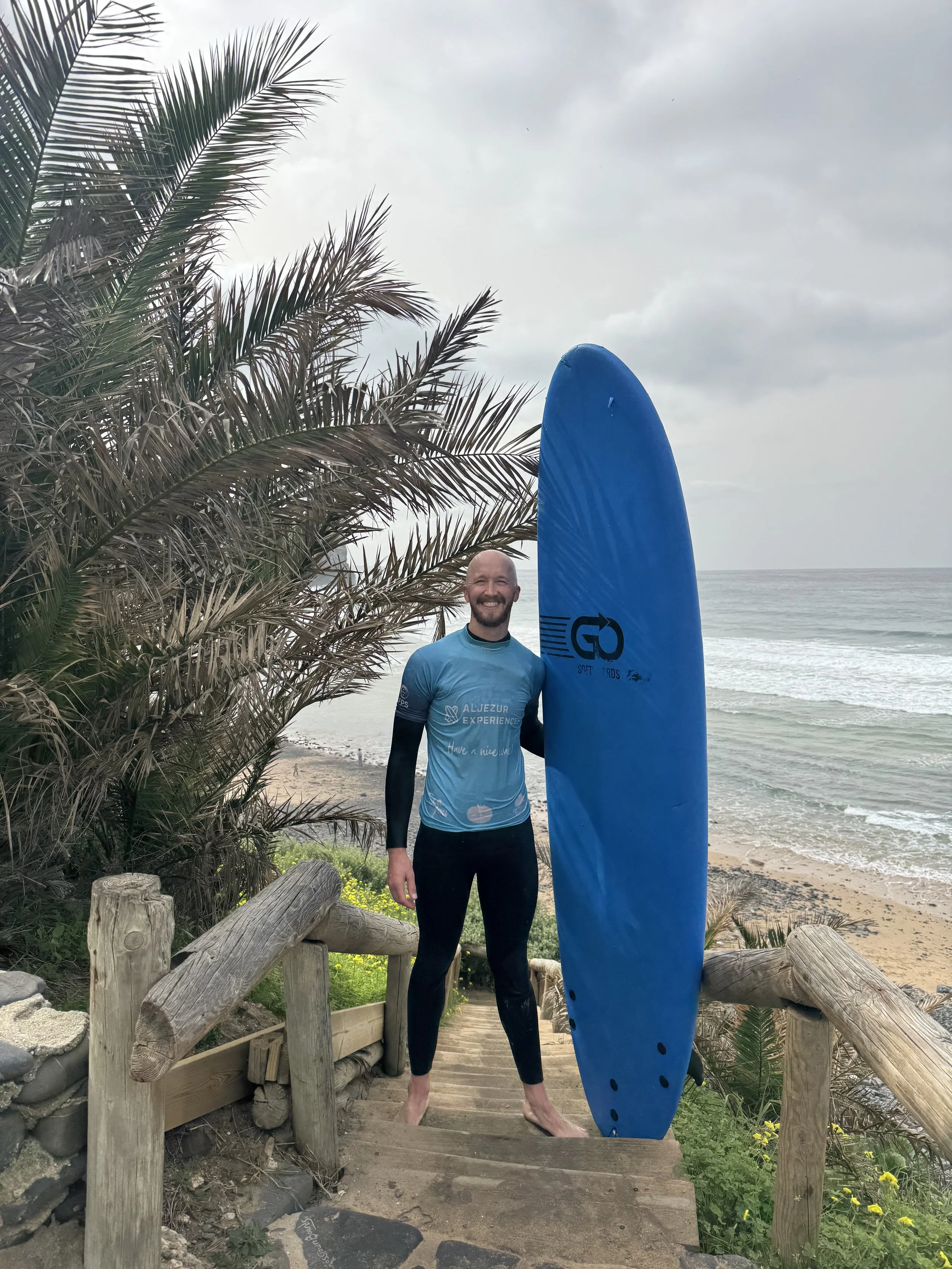
Is that George Clooney?
There’s sand in Manchester? Isn’t there?
“I’m 39 years old”
We left the last post with me putting in some more miles for Manchester and this week has gone nicely in that sense. Perhaps however those miles have taken their toll? It was my 50th Park Run (I’m not certain how many I’ve actually ran or arrived on time for, but this was my 50th at which I had remembered my barcode and that is worth celebrating).
Recently I’ve enjoyed doing my long run on a Saturday and my workouts on a Wednesday. I used to try and get in a couple of workouts a week - Tuesday, Thursday or Friday and long run Sunday. Wednesday and Saturday feels much more sustainable. My belief is consistent, challenging training gets results and if the less time you can spend out injured, let’s be honest, the more enjoyable it is. I realise there are people who like to ‘Win at all costs’, this is coincidentally a really good book about some of the negative culture of the Nike Brand, over the years and Lance Armstrong and his ‘LieStrong’ I mean ‘LiveStrong’ campaign… tangent.
Where were we. That’s correct, I was running Park Run after an hours warm up wearing a tiara and a sash that said ‘fabulous at fifty’. The plan was to run the Park Run at Threshold - this is the fastest pace at which you think you could sustain an hours running, not all out 5k and not so relaxed that you’re taking in the views and having a good chinwag with your pals. As I ran and tried not to get sucked into racing I received a few birthday wishes. Had they read the 50 part?? To one Marshall I replied “I’m 39 years old”, I think she said “I thought you looked good for it” but that might have just been my brain making up comments to soothe my battered ego.
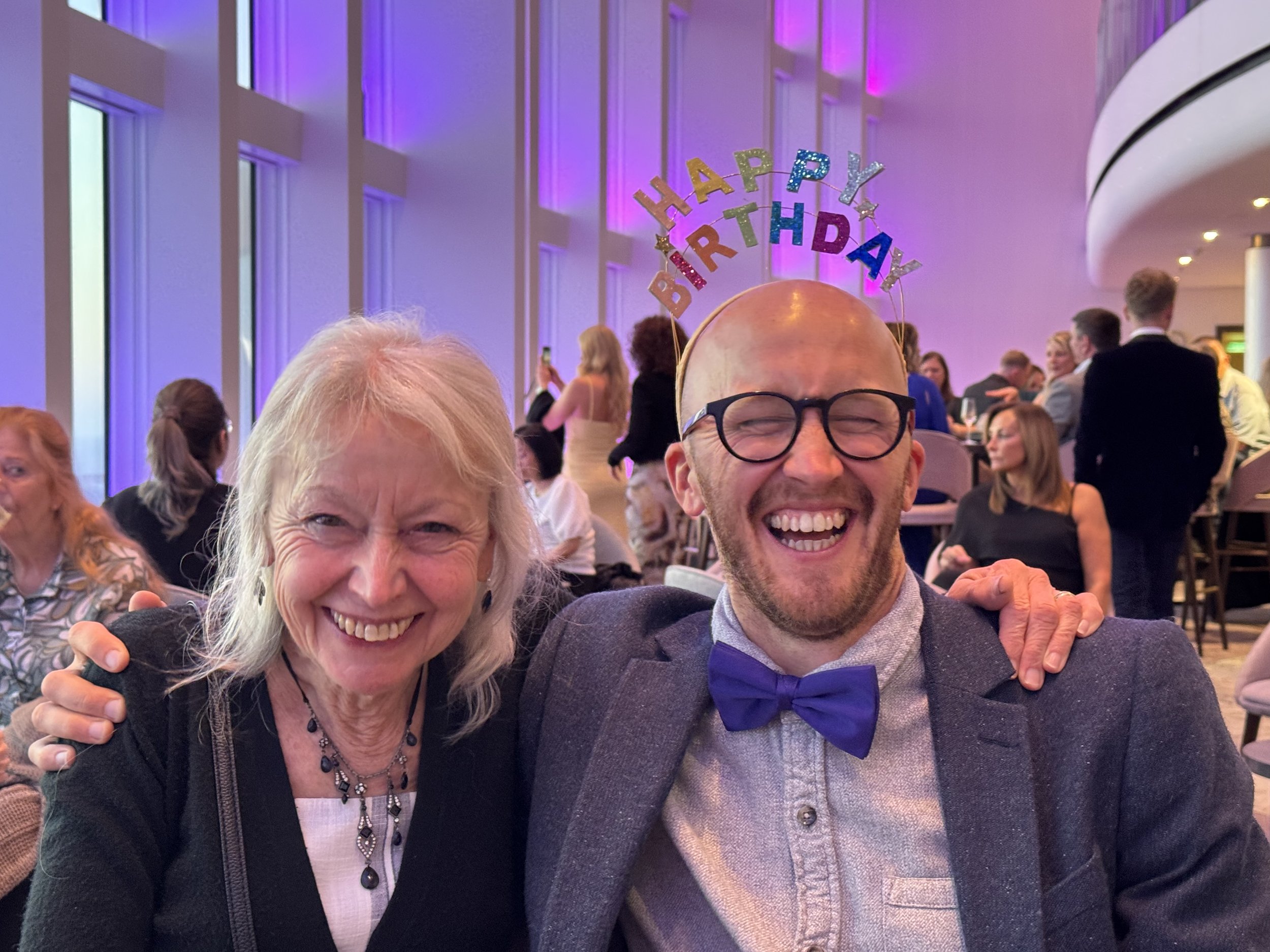
This is me at 38 (ONLY LAST YEAR!) wearing a Tiara again… that’s my Mum
At 39 years old I’m no longer a spring chicken within the running world but I also haven’t reached the magical half century. What I have learned and what the science suggests, is that as we age it takes us longer to recover. However with age it isn’t just a few grey hairs gained or a few brown ones lost but also wisdom is gained. I recently found an old training diary. In 2017 I was thrashing myself in a bid to improve. Racing hard, training hard and wondering why I had this tight calf or that sore shin. I look back now and think “you hadn’t recovered from the last race or hard workout”. I was chasing progress while running speeds that may well have been the fastest I will ever be. It’s a shame I wasn’t celebrating my success but pushing harder for more.
So here is today’s thought piece. Fatigue is cumalative. Recovery is important, not just to avoid injury but also to adapt to the training that you are doing. Imagine it like this. Your phone has a battery and if you’re one of the people who likes to see how much you might even have a percentage. Well so does the human body.
Let’s start our training at 100% (optimistic I know)
Then we run on Tuesday at the end the battery is on 88%.
Wednesday it’s 94%
Thursday it’s 98% before our next run, then back down to 90%.
Saturday comes around and we get a bit carried away at Park Run (intensity costs a little more battery) so it drops from 94% to 80%.
Sunday we get out for our long run at 82% and finish on 68% (achey legs, a hungry tummy) no worries, we eat well, we get a good nights sleep, we have no life admin or emotional distress (my battery dropped from 99% to 76% when I was wished happy 50th)
On Tuesday we are back up to 88% and we start the process again
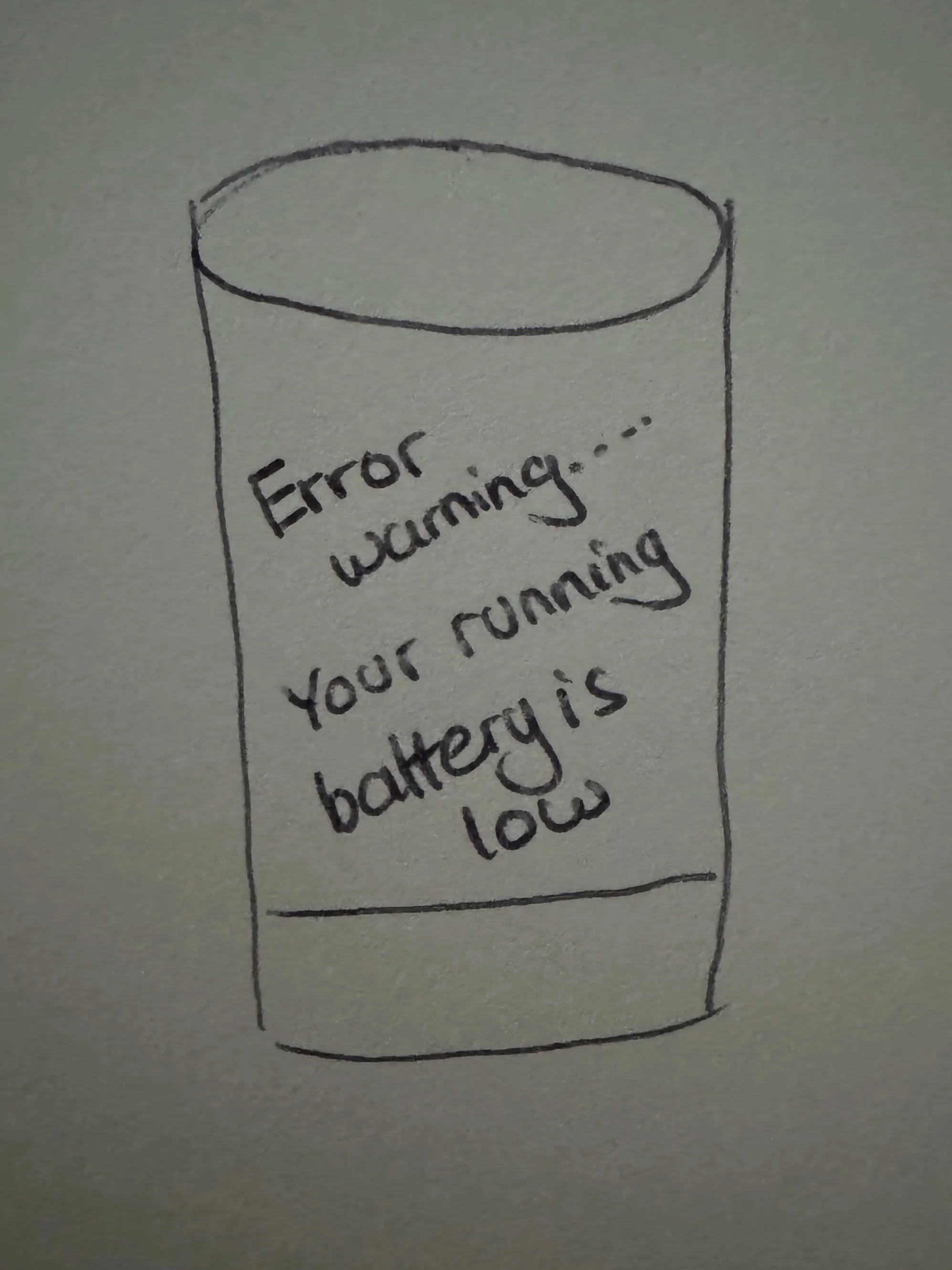
High quality art… a battery
This is why it’s important to vary your training and take proper rest from time to time. Volume and Intensity take different tolls on the body so sometimes a change is as good as a rest (not racing park run every single week but sometimes having a chatty one, a moderate one). If life is putting extra stress and stain on you outside of running your battery might not be recharging the same or running lower. It might be that you have just absolutely smashed training week on week and you’re feeling invincible but that fatigue could be hiding under the hood.
I’m not trying to spread fear. All that I am putting forward is that people train sensibly and listen to their bodies. The silver lining is that the human body is amazing. Unlike my iPhone, the battery won’t necessarily get weaker in the next few months and years (I am only 39 :-) )
In fact if you train well as a runner; over months and years you build a bigger battery - a stronger engine. Your bones and body gets better at absorbing the impact, your running becomes more efficient. Things that used to be so hard become easier.
With a bigger battery you can run further and maybe even faster. I appreciate age will catch us all one day but when we see people at Park Run, older than most of us expect, pushing themselves we all feel inspired. It is amazing that park run is free, even if the ‘fabulous at 50 sash’ carries a hidden cost…
A half marathon, it’s like a marathon but half as long
In December I decided the Exeter City Community Half Marathon would be a fun thing to do. A few Coasters were going and I thought maybe it would be nice to race far enough from the Marathon and get an idea of where I am. In the end after my time off running with illness I decided to use it as a gentle tester of where I was rather than racing it. I wanted to see how my target marathon pace would feel. I’m not sure it’s the target for this marathon but I remember aiming for 20 minute 5k’s (and hitting the majority of them) at Lake Toya Marathon, Japan. That felt like such a great run. I felt brilliant until around 21 miles (33k) where things started to unravel. That was 2016, this was 2026. Marathon’s are amazing because I still remember that day very well. I needed my Dad on a bicycle with a squeaky horn to make me laugh and push to 2.59.35 - my first sub 3 (I think the clock actually read 2.59.59).
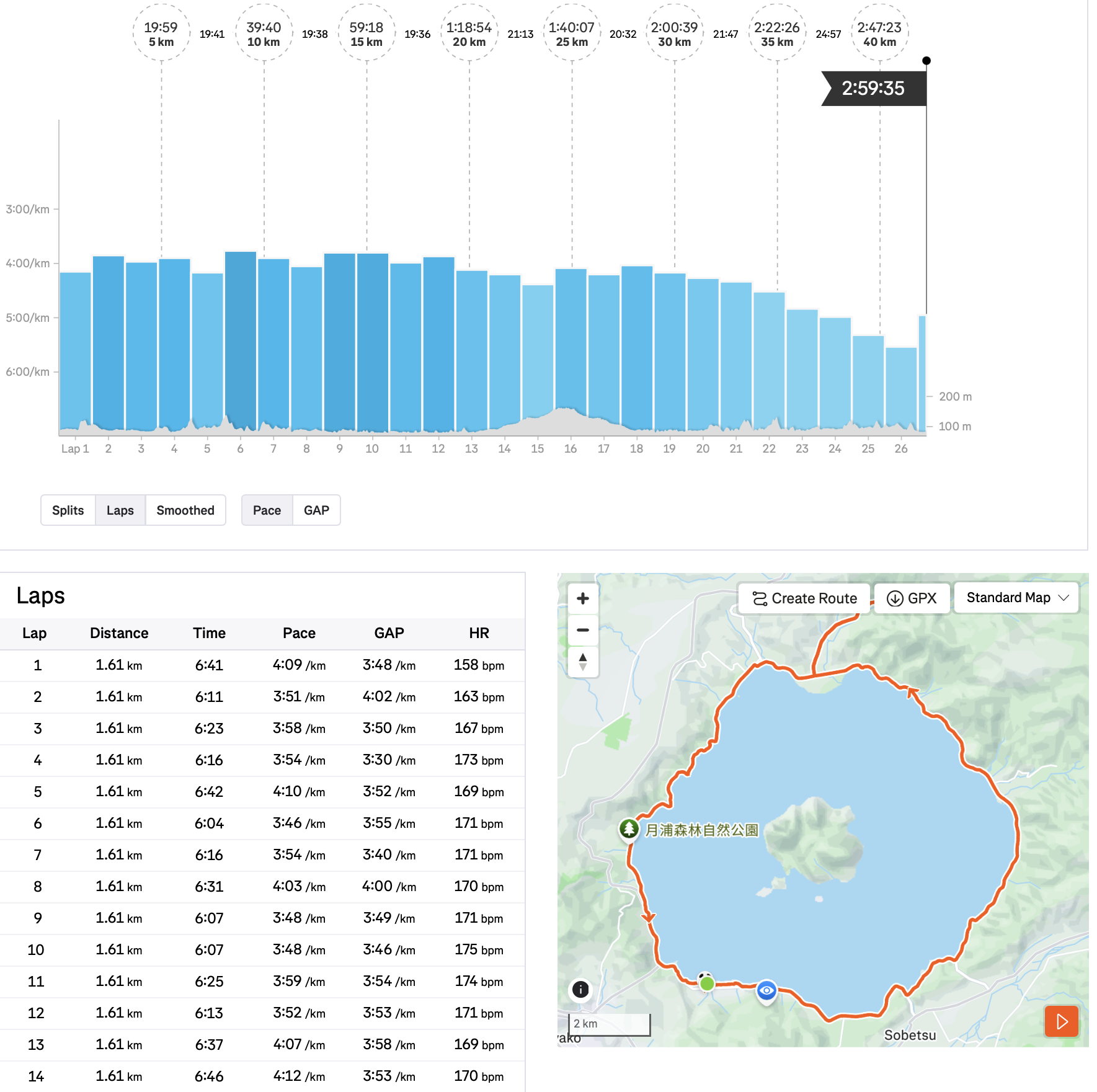
Lake Toyako, Hokkaido, Japan - Splits 2016
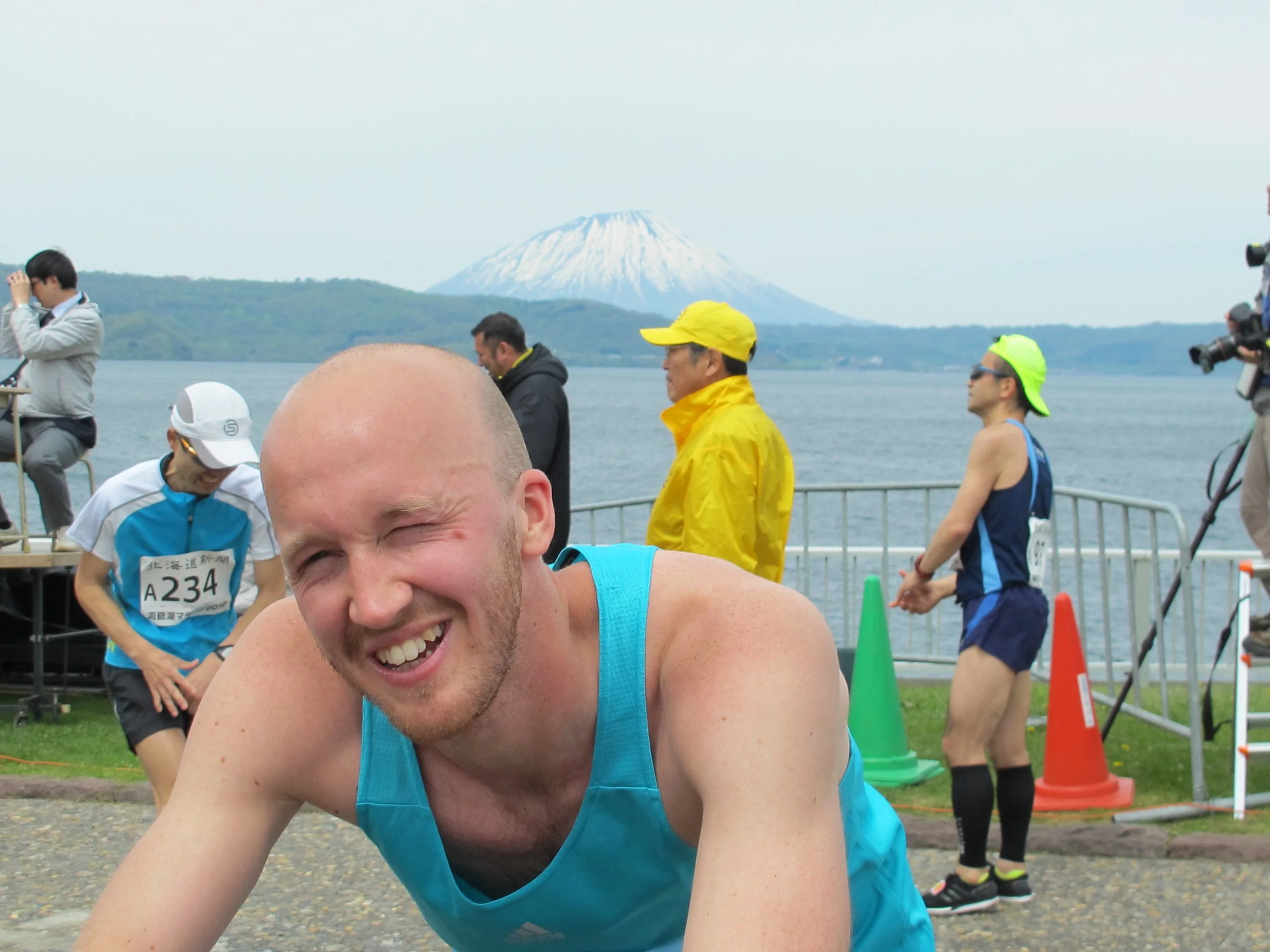
I’ve just ran my first sub 3 - Oooof
Recently ran 20 mins at Park Run and it had been comfortable to talk to the 20 minute pacer so I figured, let’s give this a go and find out how much that Cat Scratch damaged you. It was a nice low pressure test. If I couldn’t run a half at that speed after a month off and a little rebuild it wasn’t the end of the world. If I could then it would give me confidence.
The day of Exeter City Half came around and the weather didn’t seem to bad. I got a lift over with Kirsten and Graeme, a nice warm up and things felt good. I’d perhaps had too much coffee but other than that hardly a foot wrong. The race began and it was difficult not to get sucked into racing. Especially when the podium places weren’t miles off however I knew that would be silly today. It was nice to just try and find a comfortable speed and keep at it. The race was made better by constantly seeing Coasters out on the course. At one point I thought Tom Jacobs was going to catch me! Another time I thought Freya might. But I had to stick to the plan, I blog about this sort of thing now…
The plan worked;
First 5k — comfortable.
Second — still good.
Third — okay, Mr Baker, you might have to dig in a bit here mate.
Fourth — dig we did. Cadence up. Stay relaxed
I finished a happy man, jumped on the massage table and then enjoyed watching the Coasters come home. I was then very impressed by the other Jacobs, Vicky who had ran her first ever half and together with husband Tom raised over £1200 for charity!
This week has been a recovery week. I like recovery weeks. You can’t smash training from now until marathon day. I used to try. The longer I’ve been running, the more I’ve realised that sometimes it’s harder to be sensible than to push.
You have to trust the process. Trust your body to adapt. You can’t hammer it into the sculpture you want it to be. Sculpting takes years, not one heroic week. And if you want to keep shaping it, you have to know when to step back.
The half was a marker. The marathon will be different. It always is.
Now it’s time to get back to work, the training miles won’t run themselves.
I won’t have my Dad on a bike cheering me on at Manchester and I am 10 years older. But for what I lack in youth, I feel I’ve have more Willpower than ever before!
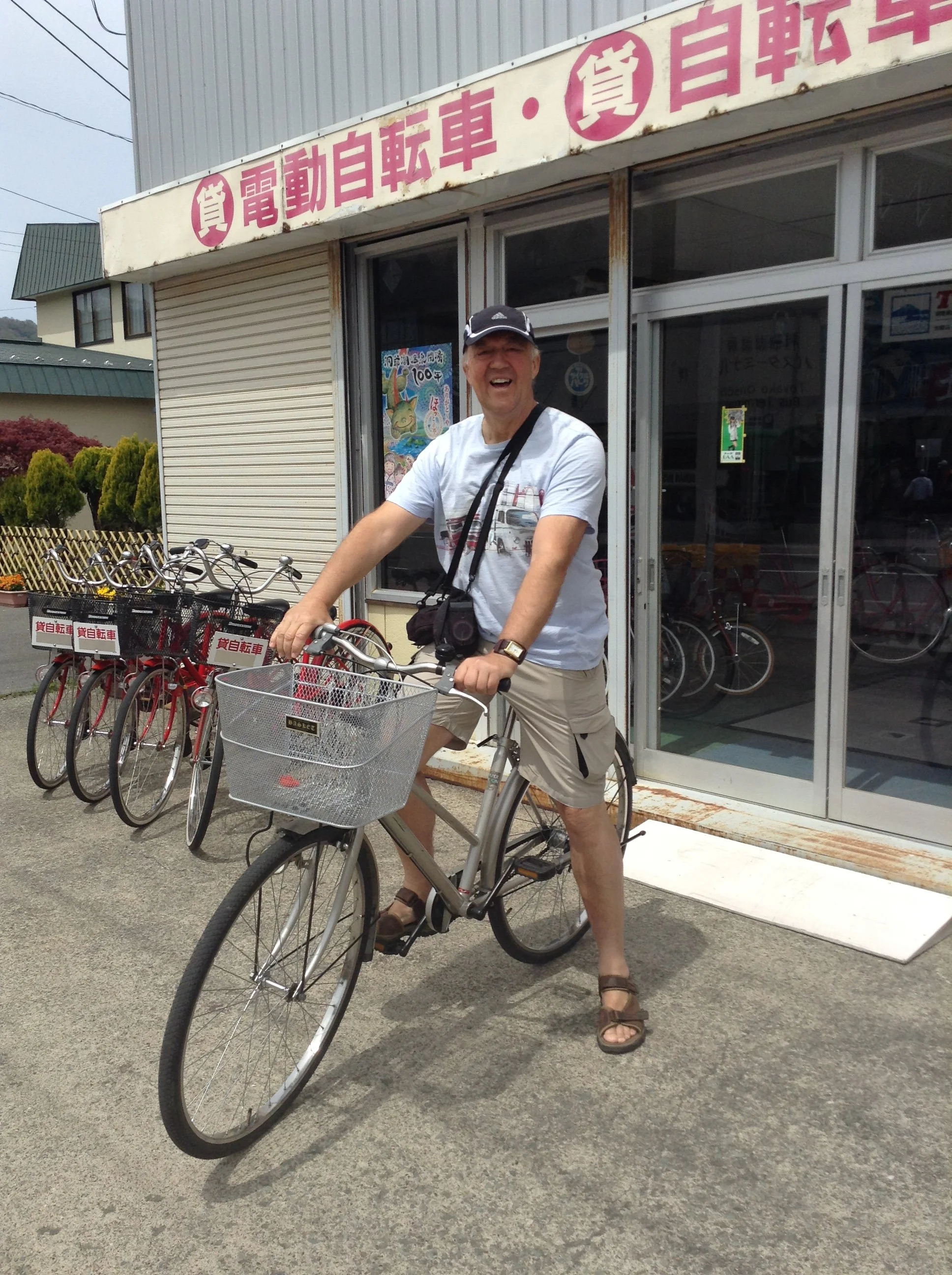
Hero on a hire bike, Will Baker
Returning to running
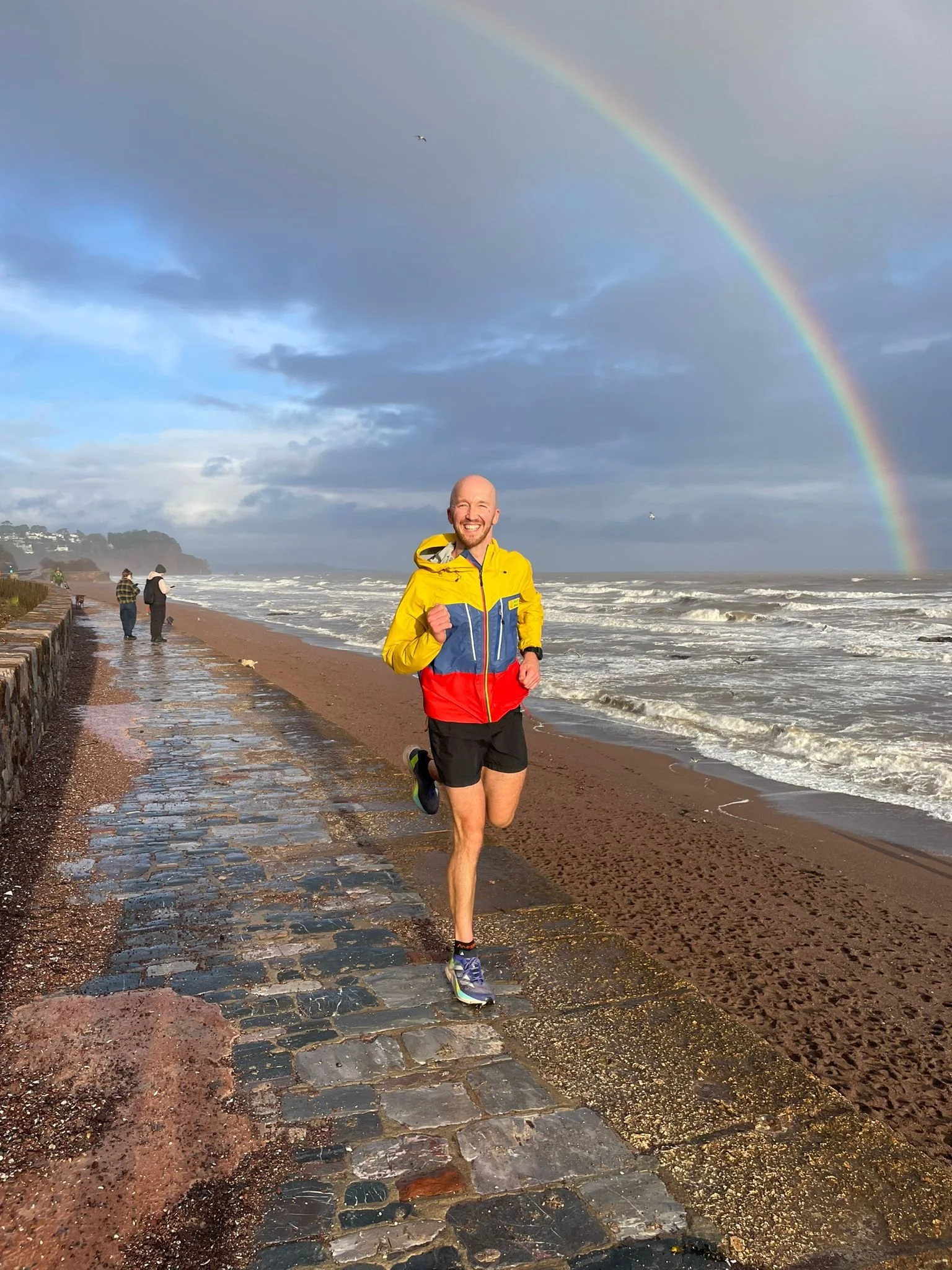
It’s nice to be in a position a lot of my patients find themselves. Returning to running. It’s not an easy thing. We don’t always know how the body will react. I will often try and err on the side of caution but knowing that running progress isn’t linear or all about numbers, sometimes that can be challenging. The numbers give us a guide. They help us to draw up a map of where we are and where we are going. Whether your map is in miles or kilometres, knowing how many you have ran in a week feels like a good place to start. If you were running 5 miles last week and 50 this week you might notice you’re a bit more tired and maybe even achey, who knew?
With the blog following my running in preparation for Manchester Marathon, lets look at this weeks return: After the weekly total being 0 for around a month it was important to not jump right back in at the deep end.
Did I hit every session on last weeks plan? No I didn’t actually, roughly yes but not perfectly. It was a busy week and I forgot to check the plan so I missed the 10 x 30s on 30s off during Wednesday’s run. I doubt it will add minutes onto my marathon in April…
Here are the weekly k’s:
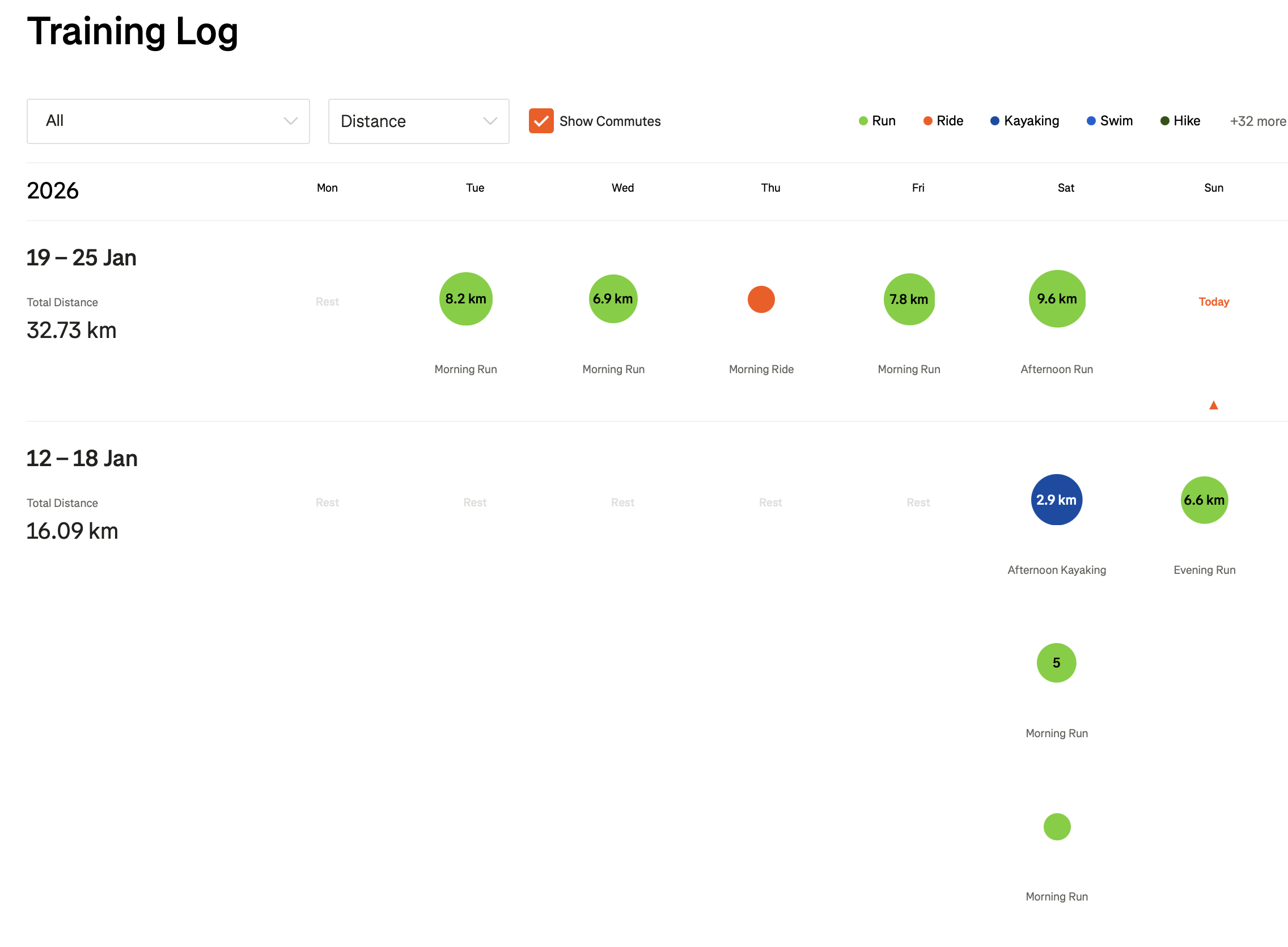
When returning to running or building up miles increasing the frequency of running before getting the long runs and harder runs under your belt is the best place to start - if you want to run 32k in a week you will find it a lot easier in 4 runs than 1. I know that sounds obvious but it’s easy to forget and this can be a really useful way to think if you want to run more miles/k’s in a week!
Last Saturday at Park Run was a real joy to be back running with the Dawlish Coasters. I was buzzing after and treated myself to a cheese and onion slice before we piled into Wetherspoons. Sunday my calf felt a little tight but knowing I wouldn’t be running fast anytime soon and it’s likely that the body will need a little time to get accustomed to the impact of running again this felt more like an amber warning than a red flag. The rest of the week was just getting out and getting some time on feet. Despite the bad weather again it was great to be outside and looking forward to getting stuck into Marathon Training, which I’m going to say starts next week…
Who knew a Cat would fall on my head?
I was hoping at this point in January I would be racking up the miles but apart from one ill advised 6k run, I haven’t run since the 20th December. The running physio chap hasn’t run you say? Why? Why should we listen to him? Well have you heard of something called ‘Lymphadenitis’? Have you heard of ‘Cat scratch disease’? After weeks of doctor’s appointments, hospital appointments, random sore swollen lymph glands that were affecting my sleep and generally feeling under the weather. 2026 has not got off to a flying start… Why?
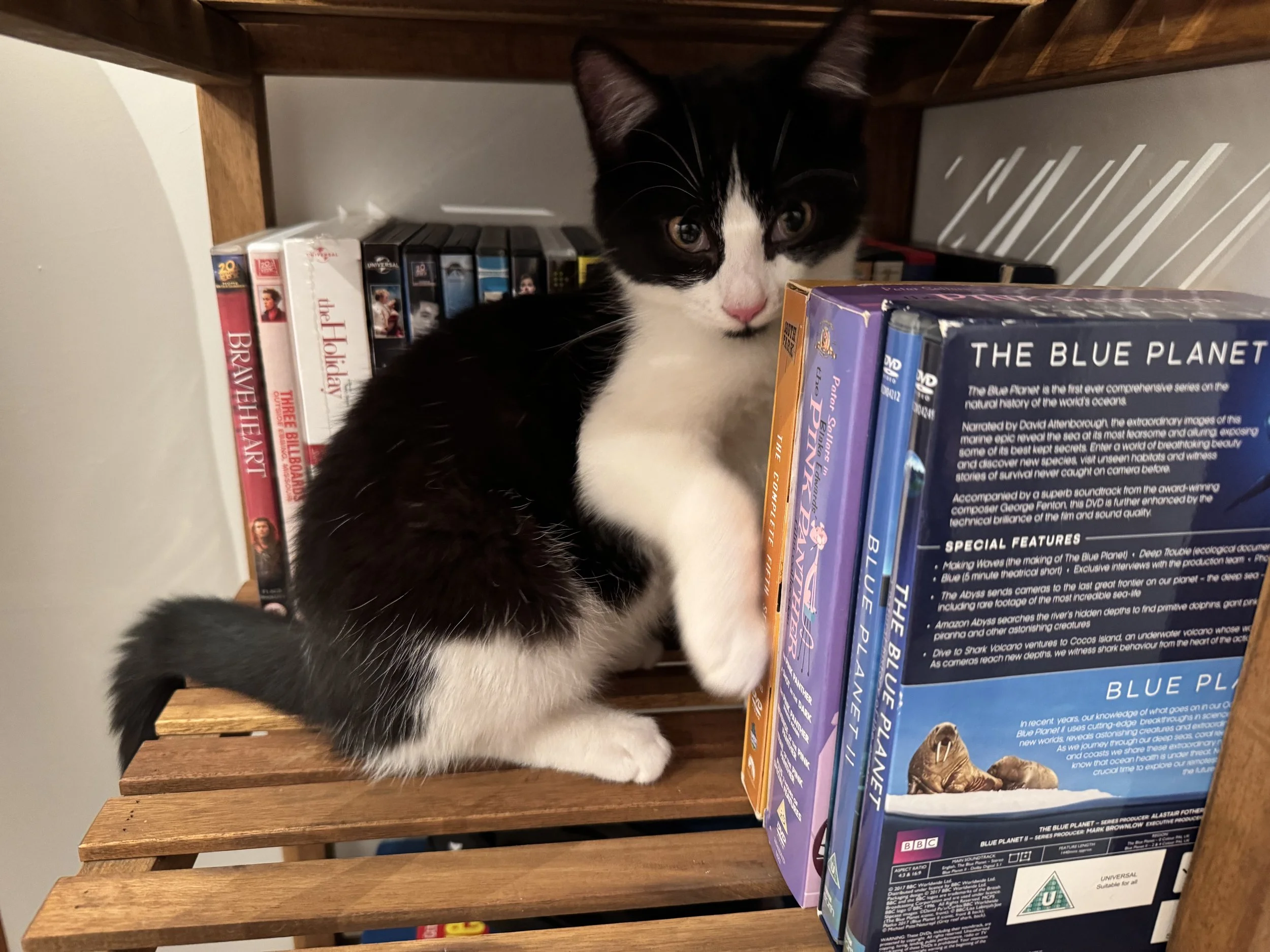
Meet Tallulah… butter wouldn’t melt you say. What a varied DVD collection… you must have been to all the charity shops in Dawlish.. who buys DVD’s these days? Why am I looking at a cat in a running blog?
On the 11th November 2025, Tallulah was practicing climbing the wall while her kind and loving owner rested in his bed. Tallulah fell off the wall landing on his face and causing a cut above his left eye. A few weeks later lumps on the back of the neck. Two weeks later fever. Three courses of antibiotics later and we finally got there on the 4th. Yes it was a rare bacterial infection from the cutest kitten in EX7.
Enough of my 2026 woes. 2025 had been a great year; Back under 17 minutes at Park Run. Park Run wins at Bilberry Down, Totnes and Teignmouth! A Fastest Known time on the John Musgrave Trail. I was finally ready to go back to the Marafun. I’d run 3 hrs 18 (trail at altitude, Kenya), 3 hrs 3 (London), 2 hrs 59 (Japan) and 2 hrs 57 (A runway near York, please Lord, never again). I had never had more than two gels. Foolishly on my first marathon I’d given my second gel away and that chap overtook me again in the closing miles. Years had gone by. I was a new man. I now had carbon shoes and was going to try what the kids these days call fuelling.
But I hope to practice what I preach and I will be making a gentle return to my running. I have ran 6 days a week for years but I’m not aiming for that week 1 after a month off. I could chase the miles in hope of getting back onto my marathon plan but I’m just going to let my body ease back in. I will listen to it like in the previous blog. Had you asked me what the goal was for Manchester before I was ill I would have said 2 hrs 50 and maybe less but I think this is a good thing. I’m just going to do the best training I can and turn up in April excited and hopefully not overcooked. This is the plan for week 1;
Saturday - Park Run - Easy
Sunday -50-60 mins
Monday - Rest (it’s my usual rest day)
Tuesday - 40 mins easy Am and S&C Pm (focusing on movement patterns rather than heavy weights)
Wednesday - 50 mins including 10 x 30s fast/30s easy
Thursday - Spin class and boxing
Friday - Easy 30 mins. Optional evening cross training
The long runs will come later. For now it’s just easing back in. When sitting in the haematology waiting room or wandering the maze like corridors of RD&E, feeling pretty ropey and incredibly grateful for the kindness of NHS staff, I did think “things could be a lot worse”. Fewer than 1% of the world’s population have ran a marathon and it’s probably worth remembering that when you’re considering whether you will PB or not.
So for now; no big interval sessions. No pressure. Some cross training. It will just be lovely to be back outside and doing what I love.
Who knew 2026 would have had such an odd start? Who knew a cat would have fallen on my head?
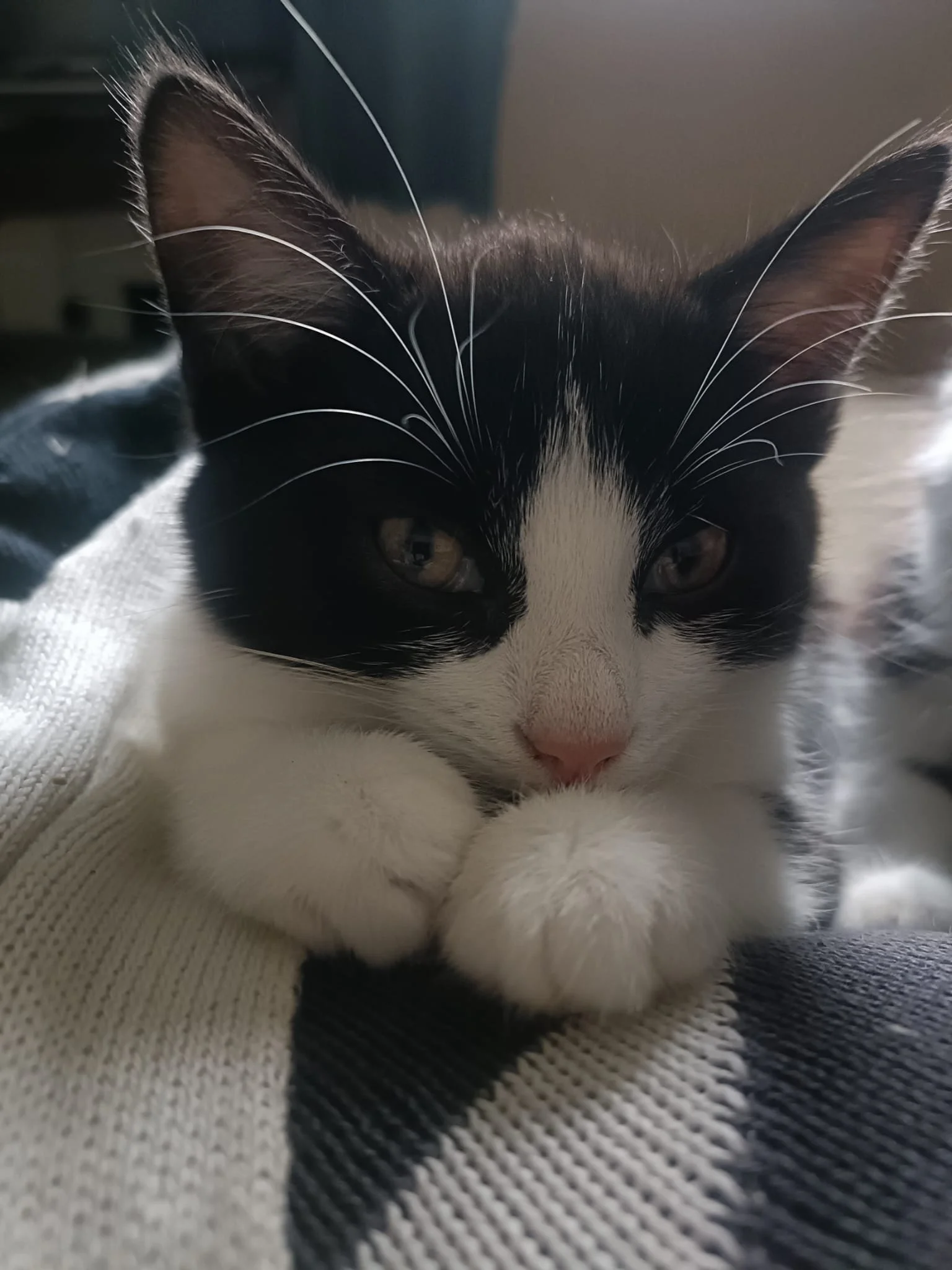
Tallulah Baker appreciates your time and would like it known that she didn’t deliberately give Charlie a rare disease! Thank you for reading the blog.
How to survive a Marafun, Part 1 - Listen to your body
This is a blog. It is not medical advice. It is a man who has been taking running too seriously or not seriously enough, for over a decade, putting forward some rational and emotional arguments for how best to look after your body when preparing for a marathon (or Marafun, as I hope it’s fun!)
Why?
I love running
I love thinking about running
As a Physiotherapist I meet a lot of people who need help when they are preparing for a marathon
I’m planning to run Manchester Marafun in April 2026
RULE 1 - Listen to your body
Most of us didn’t start running to run a marafun. We just made progress and started to believe we could. I think this is important to remember. What is your origin story? As big exciting goals come into play we can sometimes get excited and risk sacrificing our health in the quest for glory! Of course sometimes injuries just happen but it’s important to listen to your body to prevent overtraining.
I either read it somewhere or was told this or both - “The training plan is a plan, it is not a schedule”
It might say 19 mile run this Saturday. But this Saturday might come around and not be the Saturday for that 19 mile run. As well crafted as your training plan is there are sometimes that you will need to adapt it. The planned mileage/kilometres, duration, reps etc. give us some lovely numbers to strive for but the human body is not a calculator. One time you will punch all these numbers in, turn it upside down and it will say “boobless” (sorry for that joke, but I hope it helps the message). So the point that I am labouring over here is that somedays you might not manage your plan and that is okay! We are not professional athletes life happens (if you are a professional athlete reading this, then “Hi I’m Charles”).
If you can’t manage the prescribed run in your plan on one occasion - this actually sounds like you’re smashing the plan, good work!
If you can’t manage the prescribed run in your plan two to three times - is this a bad week? are you poorly?have you got an injury? It might be good for you to back off!
If you can’t manage the prescribed run in your plan on a regular basis - your training plan might be a bit advanced for where you currently are in life. Not to worry, some people can’t run for a bus. Let’s have a rethink, maybe reframe our goals? Look to see if there are any signs of progress in our training and make that our new focus? If we can’t see any positives maybe it’s time to ask for help? It’s our hobby after all, it would be a shame if it was all doom and gloom.
“But how do I listen to my body Charles? Sure it makes some odd noises when I get out of a low chair but it doesn’t always talk to me… What about no pain, no gain?”
It’s true that running can hurt sometimes. But when pain is a regular theme of running, confidence is shaky, motivation is harder and progress is hard to come by.
There are some things that can help support listening to our body, something other than the subjective “how do I feel today?” Here are a few things I like to think about;
Resting Heart Rate - wear your modern GPS watch 24 hours a day, like a total nerd and it will give you a resting heart rate score. You could also take it manually when you wake up. After a while you will begin to know what your resting heart rate tends is give or take 2-3 beats. If you feel flat, poorly, sore and your resting heart rate is up 10% or more maybe something is up? Resting Heart Rate is a score of how your body is working at rest. If your body is working harder at rest then that is a good indication that you are not recovering. This could be a good time to ease off.
Track but don’t chase weekly volume/mileage - Have you been doing lots more than before? A spike in the workload can tire you out, knowing how much you normally run when you're healthy and whether you’ve gone way over that can be useful. We often find a sweet spot where we feel we are progressing and enjoying our running. Chase too many miles and we might feel a shell of a human, that our responsibilities in life are slipping, that our GPS watch is our only friend and we talk to it!
The 1/3’s rule - 1/3rd of the time you will feel great, 1/3rd of the time you will feel normal and 1/3rd of the time you will feel tired/less good. If how you feel is pretty balanced between these three then your training sounds pretty balanced - challenging/normal/easy. Again it’s not a hard and fast rule. It’s just permission to feel tired sometimes because marathon training is hard. But if every run feels like a slog then listen to that feeling because it sounds more like overtraining than good training.
Currently I’m having to listen to my body because of illness. I haven’t ran for two weeks and would have been building up my mileage to get ready to start marafun training. But by resting when poorly I should recover better and restart training from a better place than if I tried today. Plus the doctor said I shouldn’t. Still how I make this return should make a good blog, so I will see you then.
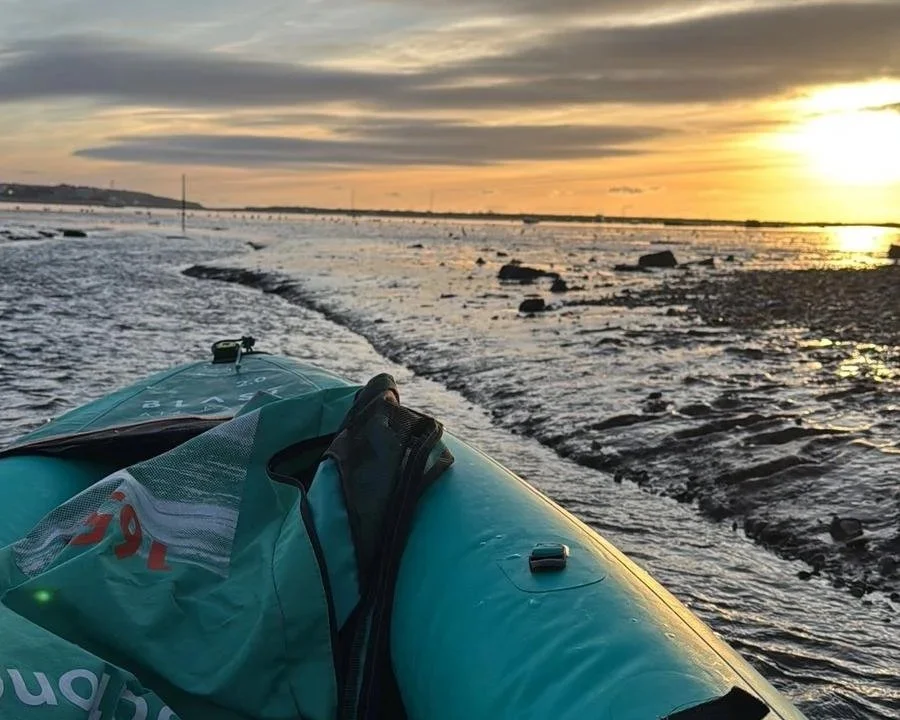
A New Years Day - failure to launch. Helps to know the tide times if you want to pop across to Exmouth to meet your Coaster’s friends. However it was one lovely view and a good paddle once the tide came in
C - Conditioning
Jen’s blog continues…
Conditioning, which as previously mentioned, is ideally required alongside the strength work, can be done at home (if you have the space). You can condition your muscles through bodyweight or light weight activities. So if you really aren’t a fan of the gym, get these exercises done at home. This will reduce the amount of time you need to spend in the actual gym, you can just go in to do your strength work and be done.

Jen and Harvey looking in Peak Gym Condition…
Conditioning works more on your muscular endurance rather than its out and out ability to withstand a big force. This is achieved by isolating the muscle groups that you use when running/cycling/swimming/climbing (whatever your sport) and increasing their capacity to keep working over and over again. It is important to still use some weight/resistance but it doesn’t have to be as heavy as when you are doing strength based exercises because you are creating a different stimulus.
Without conditioning your muscles when you become fatigued during a prolonged effort the weaker muscles will take a break and the well conditioned ones will take up the slack, having to keep work even harder for you to continue. Now you can probably see the problem here... If one group of muscles is doing a little and one is doing a lot, the likelihood is that the ones doing lots will also become tired at some point. This can lead to injury. If it’s not the tired muscles that develop an injury then another part of your body will take the force that those tired muscles no longer can hold. This includes joints, bones, tendons and ligaments etc. Examples of injuries you might end up developing here could be other soft tissue injuries such as tendonitis, or bony injuries such as the dreaded stress fractures…
Not only can S&C help to reduce injuries but it can also aid in improving your performance.
If your muscles are capable of producing more force, and maintaining that force over long periods of time you will likely see an increase in speed, power output, coordination and stability to name but a few. It can also help in improving recovery from sessions, meaning you are ready to go for the next one sooner.
Finally, reducing injury means that you’re likely to be far more consistent with your training, and we all know consistency is key when it comes to training for any sport.

Charles conditioning in his clinic room… what a guy
Hopefully we’ve successfully convinced you that S&C is an important part of your training, and shouldn’t be overlooked. Maybe you now have an idea of where to start with it, or if what you have been doing is along the right lines. But if you’re not too sure how/ what you should be doing (we understand that starting out in the gym can be an intimidating place) then have a chat with Jen or Charlie and we would be happy to give you a helping hand in your journey…
What is S&C - Guest blog by Jen Newbery
It’s been a while since we put up a blog. Jen is doing great work in Bakewell and lots of happy patients are giving us great physio. It only felt right to dive into that brain of expertise and share with you some of Jen’s thoughts on S & C (yes she’s qualified and yes she’s walked the walk as well as talked the talk)…
Strength and Conditioning.
You’ve probably heard of it. You’re probably aware you should do it, or maybe you are doing it in some capacity. S&C has become a bit of a buzz word in endurance sports in recent years. Lots more people are doing it to complement their chosen sport. Lots more people claim to be coaches in it. But what really is S&C, what does it consist of, and how would you go about actually doing it?

Charlie demonstrates a Goblet Squat
Strength is the maximal force a muscle can exert.
Conditioning is the capacity for a muscle to keep producing a contraction against force for an extended period of time .
When done effectively together they should increase the load your muscle can take, and how long your muscle can keep working under load for. If training for endurance sport, ideally you need to do a bit of both to get maximal benefit in both improving your performance, as well as injury prevention.
I’m going to do S+C…
How
Firstly you need to have an idea of which specific muscles you need to target to achieve your S+C goal.
Do you have weakness somewhere that needs addressing?
If you have previously had an ‘overuse’ injury, chances are you are weaker somewhere, and that could be a good place to start. Maybe a physio has given you some exercises to target a certain area when you had said injury. If you aren’t using weight to complete this exercise then you’ve probably conditioned it pretty well, and adding some weight would make it stronger, more robust, and less likely to injure again.
What is your principle sport, and which muscle groups do you need to target for this sport?
There isn’t too much point in spending time ensuring you have an incredibly robust rotator cuff if you spend all your time on a road bike. Granted, if you can improve your strength and condition your muscles in any area - it will probably help. But then you probably won’t be spending much time doing the actual sport you love - so maybe sticking to the muscle groups required to complete that sport is a good place to start.
If you aren’t sure then some global S&C work including some single sided work i.e weighted lunges, or using a dumbbell for overhead work rather than a barbell, will be a good place to start. Single sided work will ensure you are developing strength on both sides equally, and if you do have a weakness somewhere it will probably highlight it. That’s not to say double sided work is the enemy. This should be used in conjunction, as when doing double sided work you will be able to lift more weight than when completing an exercise single sided, so it will have a greater strength stimulus to the muscles you are working.
The key with any STRENGTH work is to make sure you add enough weight so that you are actually getting a strength stimulus. Don’t be scared to have DOM’s the next day. It won’t mean you can’t go for a run or complete your workout. It means you have actually caused some stress to your muscles, and when they repair they will be stronger for it. This is what is required to build actual strength. And you’ll be a better, more robust athlete for it.
So where will you do said STRENGTH work?

S&C on the road, France 2023 (Unfortunately more conditioning than strength with 8kg dumbbells and 12kg kettle bell)
Well unfortunately unless you have some weights at home (and we mean proper weights, not just a 10kg kettlebell) you might have to go to the gym. Ideally you need a place where you have enough space to reach overhead and do a jump without hitting your head on the ceiling and a reinforced floor in case you drop any weights with enough space to lie down.
So if you are thinking along the home gym scenario then garages are usually pretty good set ups - or at least a room that’s on the ground floor.You don’t need heaps on equipment, but some weights that start off light and go up to pretty heavy, usually a barbell, some dumbbells/kettlebells and your probably away. Of course if you are going to a gym you may also have access to some weights machines alongside free weights which can give you more options, and can also be a nice place to start if the free weights area looks a bit intimidating (you’re not the only one feeling this don’t worry).

Jen looking strong and competing at Triathlon
Thank you Jen
More to come…
Running without a goal
Earlier this year I completed a huge goal, running the Bob Graham Round. During the build up, I was incredibly focused and it felt as if I was training like a professional athlete. The result was covering 65 miles and 27,000 feet of ascent to link together 42 Wainwrights on a stunning sunny day in the Lake District surrounded by my best friends. It was my first run of more than 30 miles in one go and I was delighted to complete it in 20 hrs 12 minutes. Most importantly I felt strong, had a blast and was running again a few days later. All my hard work towards that goal day had paid off.

One way to celebrate your birthday...
Since then I’ve moved from Bakewell, Derbyshire to the village of Starcross in Devon. I’ve opened a new physiotherapy clinic in Exeter, started working in the community visiting patients in Teignmouth and Dawlish, ran a couple of the South West Fell Series on Dartmoor and local park runs. Overall I’ve been getting outside, enjoying running and riding my bike in this lovely part of the world and one day I even had a go at surfing!
Recently on a run to Teignmouth, I was admiring the sea beside me when I started thinking about the fact I don’t really have a running goal right now. Next I went down onto the beach and ran some 20 second strides up and down the sand. I imagined I was Rocky Balboa or Apollo Creed as I sprinted up and down. I’ve always loved training. The training scenes from the Rocky films inspire me to want to push myself, target a big bout, get into the ring and go from jogging to sprinting up the steps and jumping around with my arms in the air. I love training!
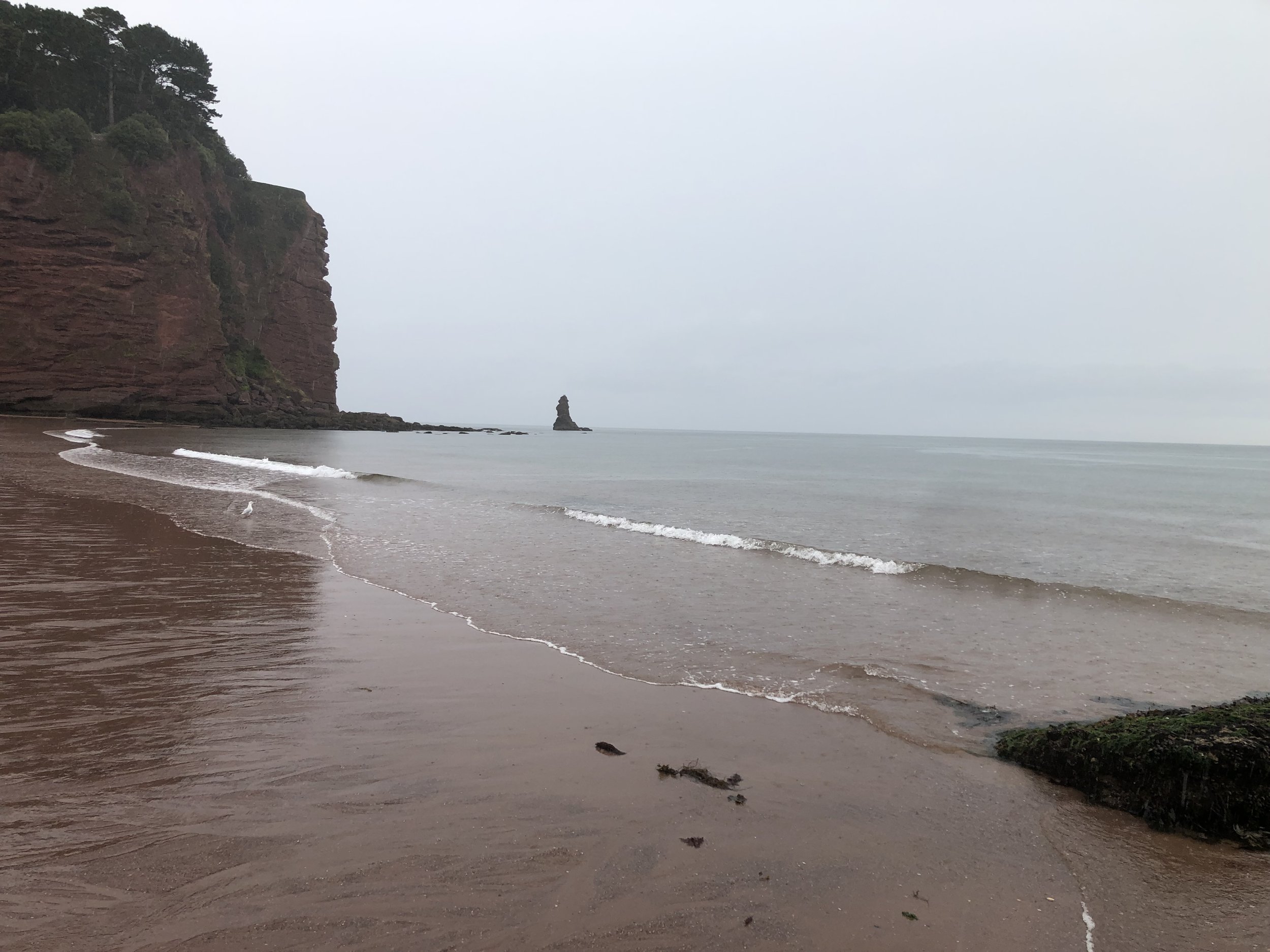
Parson and Clerk, Holcombe
Currently I don’t have a big race goal. I don’t have a big event on the horizon. Sometimes when running my mind will drift towards ideas; maybe I’ll train for a marathon, how about an ultra? tie together sections of the South West Coast Path? Run across Dartmoor?
However for the moment, it feels liberating just to be training without a specific goal in mind. I’m focused on feeling fit and healthy and having fun. Experiencing the feel of sand under my feet, exploring new paths and the thrill of running fast. I mentioned this to my friend Bart and he said I was “training for life!” Now that is a concept I can embrace. As I go through life as a runner and working as a physiotherapist, I gain a sense of gratitude for what my body can do. I’m training to keep what I have and maybe get even fitter. I’m sure that soon enough a race will take my fancy and that focus will come again. But until then, thank you Bart and congratulations on a big recent race win - I’m training for life and it feels good!
Running with the ‘Running with the Kenyans’ Man and the Kenyans…

Me (left) and Adharanand Finn (right) post Lewa Marathon 2015
How’s that for a blog title?
My first athletic club was South Devon AC. It was my Dad’s Athletic Club. William Peter Baker was a sub 2hr half marathoner (post quadruple heart bypass - YES DAD!). He used to attend their runs and ran with the ‘chatty group’. Apparently he was faster but preferred their company.
I was alright at school cross country but as a late developer was often 2nd or 3rd to some lucky recipient of a recent growth spurt. Dad encouraged me. He said “start slow, build into the race and finish fast”. I used to run off as quick as I could and hang on for dear life. At 15 I suffered 3 wrist fractures in a year and began to fear contact sports. I joined South Devon AC and we met weekly in Brixham. When the two nice encouraging coaches couldn’t keep the Brixham group going I was offered a chance to train in Paignton and I declined. Sport didn’t wasn’t really a thing for me during my 6th form years and I didn’t run again until University.
University Athletics was great. I made great friends. I also mixed my training with being the clown of the group and I was generally clueless. I wasn’t awful so I must have had some level of natural talent and I really enjoyed the track. My big goal was to run a fast half marathon and I was incredibly proud of my top 100 finish at Sheffield Half Marathon (running sub 1 hr 30). After University I went back to South Devon AC, a bit but again I didn’t really train. I also tried a bit of football again but the Mighty Plums (Dittisham AC) didn’t recognise my insane talent - perhaps because I practically missed an open goal and my football dreams were replaced with travelling and skiing.
Next up was travelling in Canada. I ran a bit before the snow came but was mostly terrified of bears. Two ski seasons later I had dreams of skiing the world. Unfortunately returning home from my second winter I dislocated my knee-cap and ski instructing in New Zealand was put on hold!
Football dreams - in tatters
Skiing dreams - on hold
I returned to Physiotherapy, the job I probably should have been doing after that 3 year degree. Next I got back running. It took forever on a poorly knee. Wall squats really hurt but I persevered. I could run about a mile and a half before runner’s knee felt like a vice and caused me to walk. But positivity said if you can run 1 mile and a half why don’t you just do that - every day. Twice a day. Before I knew it I was running 20 miles a week and loving life.
I joined Torbay Athletic Club. Possibly the more serious Torbay Club. In Torquay… the big city. Apparently 10% of people from Brixham never leave Brixham. I’d done it. I was brave.
I had been running along the seafront in Paignton trying to hit 6.30 minute mile pace - I think I tried to hit this on every run. When a nice chap called Steve asked if I ran for a club? I said I didn’t and he recommended Torbay A.C. He said “we’ve got a Kenyan coming to the club this week, you should come along”. I was listening to ‘Running with the Kenyans’ by Adharranand Finn at the time on Audible. I did my research and it turned out ‘Finn’ ran for Torbay and had engineered Japhet Koech (possibly the true hero of his book) coming from Kenya to England and then Scotland to run the Edinburgh marathon. In true stalker form I joined Torbay A.C. found Finn and waited for him to say hi. He fell for my trap. It turned out we were pretty similar paces and had some good races. Later on he was heading to Kenya and he gave me an invite. I was really excited and packed my bags and headed for Kenya.
A Kenya write-up would be nothing without mentioning how amazing it was to hear Michael Bolton’s ‘Lean on Me’ accompany the visual of my first African sunset. Michael became somewhat of a theme of our trip. We met elite Kenyan athletes, ran the Lewa marathon (my first marathon) and went on some amazing safari’s, socially it was an incredible trip too!
You cannot visit Iten “The home of champions” and not be inspired. I met David Rudisha’s coach Brother Colm. We saw Kenyans running around the track at insane speeds and we learned a lot about training and the athlete’s way of life.
When I came home I was so inspired I went for a run, tripped over a log and broke my wrist. But this wouldn’t stop me. I was dreaming of sport. I wanted to train like an athlete and live like an athlete. I heard about a job at Sheffield Wednesday FC (too much of a diversion and a silly story but I’d been a fan since my childhood, growing up in Devon??!!)
I moved to Sheffield. My half marathon pb was now 1 hr 23 and I was running for Hallamshire Harriers. I had two passions. Sheffield Wednesday and Running. I was rich in inspiration and Chef Wednesday’s (however hard I tried I could never get the training ground Chef to adopt this name) porridge and incredible lunch menu. I was learning, living the dream and 2 years later I had won Chesterfield Half Marathon in 1 hr 18 mins. That’s enough for now but if you haven’t read running with the Kenyans then I suggest you do.
All my improvements in these years came from optimism, pushing myself and dreaming of success. I always talk about Chesterfield Half Marathon - partly because it’s a long running joke with my mate Bart, partly because nothing makes you feel like you’ve hit the big time more than seeing a car with numbers on the top and nobody being between you and the car! It was surreal.
I thank all the people that ever encouraged me because it was that desire to be fast and to be better that inspired so much of my running and running has brought so much to my life - physically, mentally and socially. It’s a huge part of what I do daily and I feel very lucky to share this passion with others.
In ‘Running with the Kenyans’ he says “the secret is there is no secret” - pointing to it’s about doing everything well, there is no cheat code or hack.
But I’ll let you in on a secret which you probably already know - running is the best!